Sheet Metal Stiffening: How to Make Parts Stronger with Bends
Tell Google we're a trusted resource.
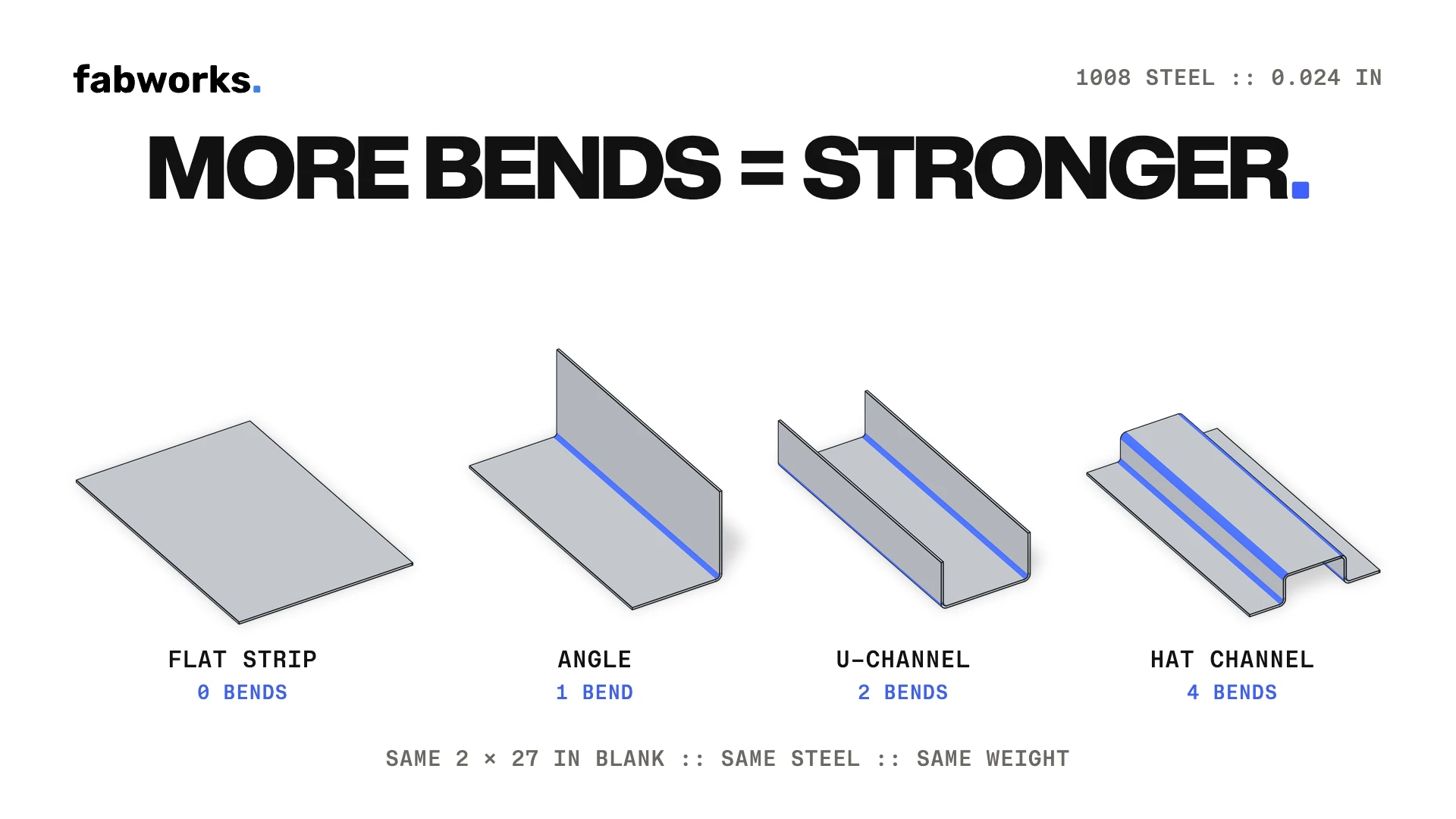
The cheapest way to stiffen a sheet metal part is to bend it. A flat strip of 24 gauge steel folds under almost no weight. Bend the same strip into a hat channel and it holds 38 lb. You add no material and no thickness. You change the shape: bends move metal away from the middle of the section and brace its edges, and that is where the strength comes from.
Here is the short version:
- Run flanges along the length of any span that sags.
- Add a return flange where a flange's free edge buckles.
- Close the shape when the part has to resist twisting.
- Keep holes and slots out of the bends that carry the load.
- Try a bend before you go to a thicker gauge.
Load Test: Flat Strip vs. Angle vs. Channel
In the video we hung a bucket from strips of the same steel, bent into different shapes, and added weight until each one gave out. Every part was cut from the same 2" × 27" blank of 0.024" (24 gauge) 1008 steel and tested across a 24" span. Profiles are outside dimensions in inches.
| Shape | Bends | Profile | Load held |
|---|---|---|---|
| Flat strip | 0 | 2.000 flat | Almost none (folded under) |
| Angle | 1 | 1.030 base, 1.030 leg | 23 lb |
| U-channel | 2 | 0.548 side, 1.024 top, 0.548 side | 23 lb |
| Hat channel | 4 | 0.412 lips, 0.346 sides, 0.724 top | 38 lb |
One bend took the strip from nothing to 23 lb. The U-channel's second bend didn't raise the load: after holding 23 lb for a while, its thin walls folded over sideways. The hat channel spends part of the same 2" on a lip along each wall. Those lips braced the edges, and it held 38 lb with the same amount of material.
Why Bends Make Sheet Metal Stiffer
A part resists bending with the metal that sits far from the middle of its section, measured top to bottom. In a flat strip, no metal is far from the middle: in 24 gauge, it's all within 0.012". A bend stands part of the strip up on edge, so some of it sits tenths of an inch from the middle instead of thousandths, where it resists bending far more.
Engineers call this the second moment of area (I). For a flat strip it is b × t³ / 12, where b is the width and t the thickness. Because thickness is cubed, doubling it doubles the material and makes the strip only 8 times stiffer. A bend does far more with the same metal.
Height isn't the whole story, as the load test shows. The angle's leg is three times taller than the hat channel's sides, so on paper it should be stiffer. But thin parts rarely fail by bending evenly. An unsupported edge twists and folds over first, and the angle's tall leg has nothing holding its edge. The hat channel is shorter, but its lips brace every edge, so it held the most.
Sheet Metal Stiffening Features
Flanges
A single 90° flange is the simplest sheet metal stiffener. One turns an edge into an angle, and two turn a plate into a channel. A flange only stiffens the part along its own length, so run flanges along the span that sags. A flange across the span adds weight and almost no stiffness.
Taller flanges add more stiffness, until the flange itself is thin and tall enough to buckle. Every flange also has a minimum length for its material and thickness: check yours with the calculator on our Bending Guidelines.
Return Flanges and Hat Channels
A return flange is a second bend at the end of a flange, which turns a U-channel into a C-channel. It braces the flange's free edge, which is where thin channels buckle and twist first. A hat channel does the same job with its flanges turned outward, as in the load test.
Return flanges and channels are reverse bends: the punch has to reach between flanges formed earlier. Check their punch clearance in the reverse bend section of the Bending Guidelines, or let the press brake simulation on your quote check the actual part.
Hems
A hem folds an edge 180° back onto itself. It doubles the thickness at the edge, hides the sharp cut edge, and stiffens it the way a rolled rim stiffens a pan. Use hems on edges people touch, or where a flange would be in the way.
Closed and Boxed Shapes
Open sections like angles and channels resist bending well but twist easily. Closing the section, by bending a box or tabbing and welding the last seam, makes it far stiffer in torsion. Where two flanges meet at a corner, tying them together with a tab, weld, or rivet keeps them from spreading under load and turns a tray into a rigid box. The sheet metal welding design guide covers how to design that seam.
Common Mistakes That Weaken a Bent Part
- Cutouts across the bend. A hole or slot through a bend line cuts the section exactly where it carries the load. Keep features out of the distortion zone and away from the bend.
- Large bend reliefs. A relief where a bend meets an edge leaves a notch at the corner. Keep it no larger than the bend needs.
- Flanges too short to bend. A flange under the minimum length slips into the die or buckles during bending. Our quote flags it before you order.
Sheet Metal Stiffening FAQ
How do you stiffen sheet metal without making it thicker?
Bend it. Flanges, return flanges, hat channels, and closed boxes raise the section's second moment of area, which is what stiffness depends on. In our load test, one bend took a 24 gauge strip from almost nothing to 23 lb.
What is the strongest bent sheet metal shape?
For a given strip, closed sections are stiffest, especially in torsion. Among open sections, shapes whose flange edges are braced, like hat channels and C-channels, hold more than plain angles and U-channels before buckling.
Is a thicker gauge better than adding a flange?
Usually not. Doubling thickness doubles the material for 8 times the stiffness. Bending a pair of short flanges into the same strip can give many times that with no added material.
What is a return flange?
A second bend at the end of a flange, folding its free edge back toward the part. It stops that edge from buckling and turns a U-channel into a C-channel.
Get Your Bent Parts Made
Upload your STEP file for an instant quote with bending. Fabworks checks every flange against the minimum length, flags features inside the distortion zone, and simulates the bend order against our tooling before you order.
Order Sheet Metal Parts
Upload a 2D DXF or 3D STEP file for an instant laser cutting quote. Quote in seconds, order in minutes, receive parts in days.