General Laser Cutting Guidelines
CNC fiber laser cutting focuses a high-power laser beam onto sheet or tube metal while assist gas clears the molten material, leaving a clean, accurate cut edge. It cuts aluminum, mild steel, stainless steel, and galvanized steel cleanly with tight tolerances and minimal heat distortion.
| Spec | Standard Value |
|---|---|
| Sheet cutting tolerance | +/- 0.005" (+/- 0.002" typical) |
| Tube feature tolerance (from edges) | +/- 0.010" to +/- 0.015" (raw mill tube tolerance) |
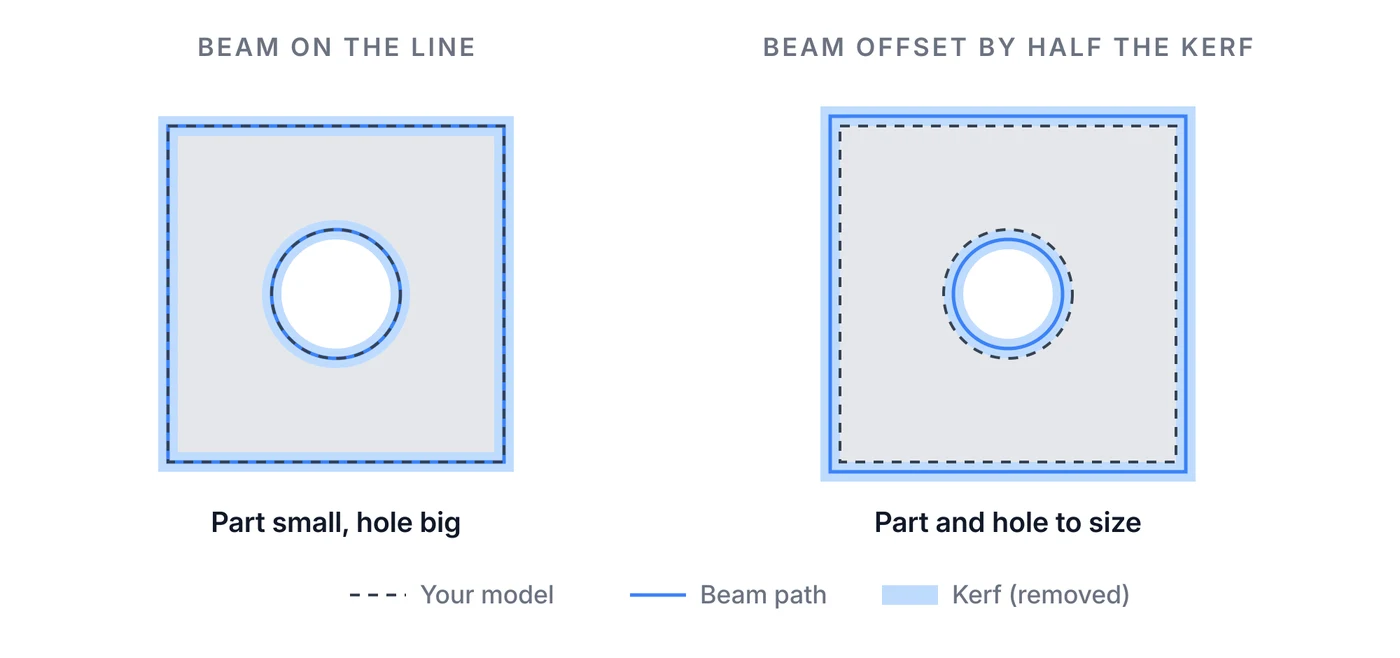
| Kerf compensation | Applied automatically by Fabworks (do not offset CAD) |
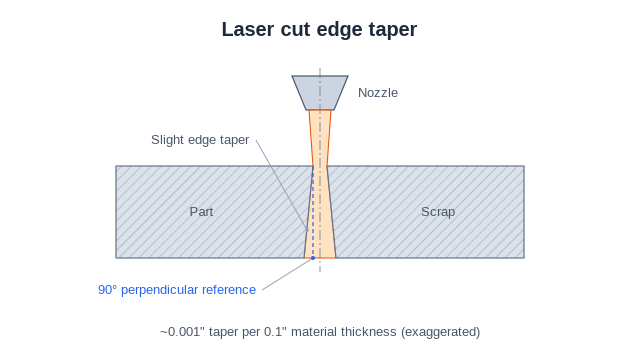
| Edge taper | ~0.001" per 0.100" of material thickness |
| Recommended web width (heat warp) | ~1x material thickness rule of thumb (quote warns on sheet webs below 0.07x aluminum or 0.085x steel/stainless, 0.008" floor; refuses tube bridges too narrow for cutting heat) |
Kerf
Kerf is the width of material removed by the laser beam as it cuts through the metal, leaving a narrow gap along the cut path. Our kerf guide covers kerf widths and has a calculator for the smallest hole a bolt or pin will clear.
Tolerance
+/-.002" typical in practice. The +/-.005" standard covers hole sizes, outer dimensions, and hole-to-hole spacing across the entire part.
There are a few cases where you can see worse tolerances including:
- Very long and thin parts that will deform while cutting
- Thick parts with lots of cutouts that will require lots of heat to cut
- +/- .010" typical on features located relative to tube edges
Thin strips of metal between closely spaced cuts are the most common cause. See minimum web width and heat distortion for how wide to make them.
Taper
Laser cutting produces a slight taper, so cut edges are angled rather than perfectly perpendicular to the sheet surface. Account for this on tight-fitting features, since it affects both edge appearance and final dimensions.
Surface Finish
Laser cut parts ship with a smooth, clean edge, minimal burrs, and a narrow heat-affected zone (HAZ). Deburring is the default finish on every part.