How to Bend Square Tubing Without a Bender: Relief Notches and Kerf Cuts
Tell Google we're a trusted resource.
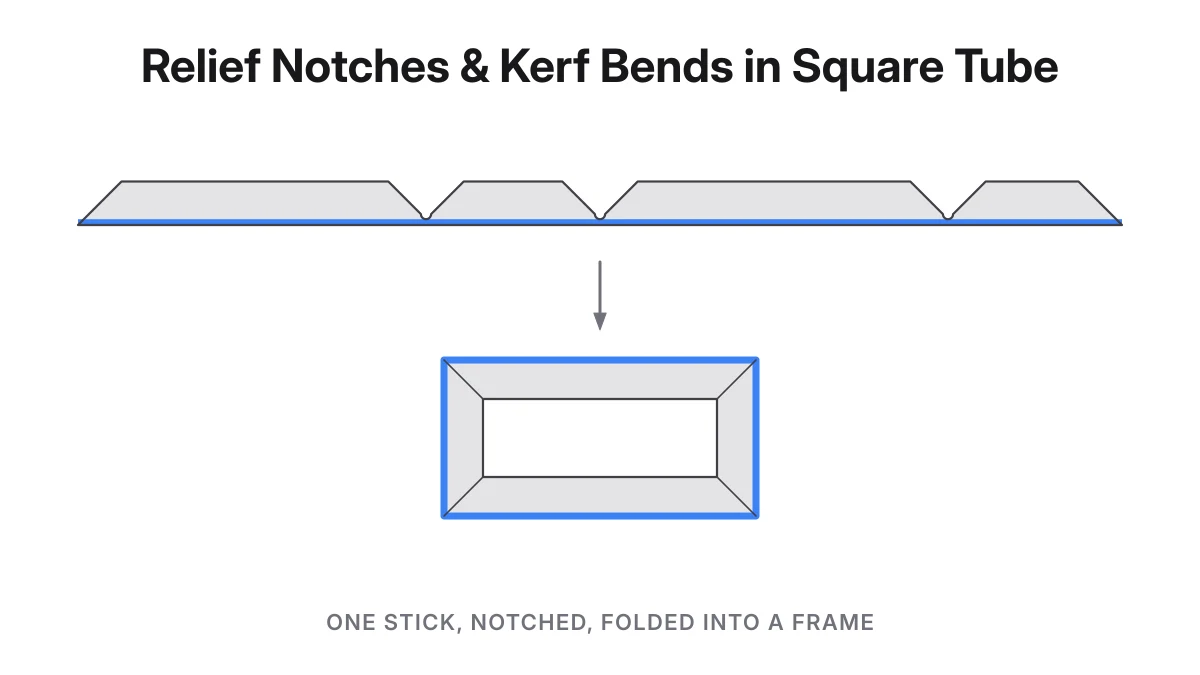
You can bend square tubing without a bender by cutting relief notches or kerf slots into it. You cut away most of the tube's cross-section at the bend and leave one wall intact as a hinge, then fold it by hand or in a vise. A V-shaped notch folds into a sharp frame corner, and a row of narrow kerf slots folds into a curve made of short flats. Because the hinge wall stays attached, the folded part keeps its alignment and length, so a single straight stick can become a whole welded frame with very little fixturing.
A tube laser cuts these straight from your 3D model, so every notch lines up along the stick and the hinge wall is the same thickness at every bend.
Here is the short version:
- Use square or rectangular tube. Round tube has no flat wall to act as a hinge.
- Leave one wall intact as the hinge, and put it on the outside of the bend.
- For a sharp corner, cut a V-notch whose included angle equals how far the tube turns.
- For a curve, cut a row of kerf slots and size their width and spacing from the bend radius.
- Finish each notch and slot at the hinge with a round relief, not a sharp point.
- Model and upload the tube straight, with the notches cut, exactly as it comes off the laser.
- Use steel for anything you plan to fold. 6061-T6 aluminum tends to crack at the hinge.
How Relief Notches Bend Square Tubing
Square tube is very stiff in bending because it has four walls working together. A relief notch removes three of them at the bend line and leaves the fourth as a thin, flat strap. That strap folds easily, much like a hand-bent tab in sheet metal (see the hand bending guide), while the cut faces of the other three walls swing together and close the notch.
When the notch is sized correctly, the cut faces meet flush at the finished angle. That gives you a tight, self-squaring seam to weld, and a corner that is located by the tube itself instead of by a fixture.


Choosing the Notch Angle
The notch's included angle should equal the angle the tube turns through at that corner, which is the deflection angle, not the angle inside the finished corner. For a square frame, each corner turns the tube 90 degrees, so each notch is a 90-degree V. For a regular polygon, the deflection at each corner is 360 degrees divided by the number of sides.
The width of the notch opening on the inside face sets how much material comes out. With H as the distance from the inside face of the tube down to the inside surface of the hinge wall (the tube's height minus one wall thickness):
For 1" × 1" square tube with a 0.065" wall, H is 0.935", so a 90-degree notch opens 1.87" on the inside face.

The easiest way to model this is in a side view. Sketch the V on the side of the tube with its apex on the inside surface of the hinge wall, then extrude-cut it through all. A single through-all cut removes both side walls and the section of the inside wall in one feature, and leaves the hinge wall untouched.
Laying Out a Square Tube Frame From One Stick
To make a closed frame from a single piece of tube, put the hinge wall on the outside of every corner. The hinge wall then becomes the outside face of the frame, so lay the notches out from the frame's outside dimensions. Each fold adds a little length as the hinge wraps around the corner, about 1.4 times the wall thickness at 90 degrees, so take that fold deduction out of the spacing between notches and half of it at each end of the stick. The stick has to fit our 96" maximum part length.
For example, a 24" × 12" rectangular frame in 1" square tube with a 0.065" wall has a 72" outside perimeter, and each 90-degree fold takes out 0.089", so the stick is 71.733" long. If the closing joint is at a corner, start and end the stick with matching 45-degree miters and place notches at 23.955", 35.866", and 59.777" from the start, measured along the hinge face. Notches at exactly 24", 36", and 60" would make each side about 0.09" too long, and the frame wouldn't close square.

A few things to plan for:
- Closing joint: the two free ends meet at one corner with matching end miters. Our tube laser cuts miters up to 45 degrees, so a triangle (which would need 60-degree miters) closes in the middle of a side with square cuts instead.
- Fold deduction: the deduction assumes the hinge folds around a near-zero radius. The wall, the relief size, and how you fold all shift it slightly, so fold one test corner and measure it before a production run.
- Order of folding: fold and tack one corner at a time so earlier corners don't spring open.
The calculator below sizes the notches and lays them out on the stick for your tube and frame.
Tube Notch and Frame Calculator
Size the V-notches for a fold-up frame and lay them out on one straight stick.
- Notch included angle
- 90.0°
- Notch depth H
- 0.935"
- Notch opening on the inside face
- 1.870"
- Relief round diameter
- 0.065" to 0.130"
- Stick length on the hinge face
- 71.733"
- Fold deduction, taken out at each notch
- 0.089"
- Notch positions from the start
- 1: 23.955", 2: 35.866", 3: 59.777"
- Closing joint
- At a corner, with 45.0° miters on both ends
Positions are measured along the hinge face, which becomes the outside of the frame. They already take out the fold deduction, so the folded frame comes out at the outside size you entered. Fold one test corner and measure it before a production run.
Kerf Bending Square Tubing Into a Curve
A row of narrow slots works like one big notch spread out. Each slot closes by a small angle, and together they turn the tube through the full bend, with the hinge wall on the outside of the curve. The webs between slots stay straight, so the tube only folds at the slots: a kerf bend is a run of short flats whose corners sit on a circle, not a true arc.

Three numbers define a kerf bend: the number of slots N, the slot width w, and the pitch s (center-to-center spacing). Work them out in this order:
Slot width w = 2 × H × tan(α / 2)
Pitch s = 2 × R × sin(α / 2)
R is the radius of the circle the fold points on the hinge sit on. Each web is a chord of that circle, and its middle sits R × (1 - cos(α / 2)) inside a true arc. More slots make shorter flats and a smoother curve, but they add cutting time and thin the webs.
Kerf Bend Example
A 90-degree bend in 1" × 1" × 0.065" steel square tube, with a 4" radius at the hinge and 12 slots:
H = 1 - 0.065 = 0.935"- Angle per slot:
90 / 12 = 7.5° - Slot width:
2 * 0.935 * tan(3.75°) = 0.123" - Pitch:
2 * 4 * sin(3.75°) = 0.523" - Web between slots:
0.523 - 0.123 = 0.401" - Flat deviation from a true arc:
4 * (1 - cos(3.75°)) = 0.009"
That leaves webs about six times the wall thickness. Webs much thinner than about three wall thicknesses can buckle instead of letting the slots close cleanly.

The calculator below does this math for your own tube, bend angle, and radius.
Kerf Bend Calculator
Work out the slot width and spacing that bend square or rectangular tube to a radius.
- Slot width w
- 0.123"
- Pitch s (center to center)
- 0.523"
- Web between slots
- 0.401" (6.2× wall)
- Slot depth H and angle per slot
- 0.935", 7.50°
- Slotted length on the hinge face
- 6.279"
- Flats' deviation from a true arc
- 0.009"
- Most slots with webs at least 3× wall
- 24
Prototype one bend in the real material before relying on the exact radius.
Slots don't have to be evenly spaced. Varying the pitch gives a curve whose radius changes along its length; work out each slot's share of the bend separately.
Relief Rounds at the Hinge
Where the notch or slot meets the hinge wall sees the most strain when you fold. A sharp V point concentrates it, and that's where cracks start, while folding or later in service.
End every notch and slot at the hinge with a round relief instead. In the side-view sketch, add a circle at the apex and include it in the same through-all cut. Start with a diameter of one to two wall thicknesses: larger reliefs fold more easily but leave a bigger gap at the root of the weld.

Steel vs. Aluminum Square Tubing
The hinge is a tight, permanent bend in the tube wall, so the material has to tolerate being folded nearly flat.
- Steel tube is the best choice. Mild steel folds cleanly at the hinge and welds easily once the joint is closed.
- 6061-T6 aluminum tube tends to crack on a tight bend, like 6061 sheet in the hand bending guide. For an aluminum frame, cut the corners all the way through and weld them as miters, or prototype one fold first.
Thinner walls fold more easily by hand. Thicker walls work, but they need a vise, a longer lever, or a fixture to fold consistently.
Uploading Notched Tube to Fabworks
Our tube laser cuts straight stock, so the part you upload should be the straight tube with every notch and slot already cut, not the folded frame.
- Model it straight: design folded if that's easier, but export the unfolded stick as your STEP file, usually as a separate "as-cut" configuration or part. Both calculators above can download the side profile as a DXF to extrude-cut into a straight tube in your CAD tool.
- Leave corners sharp: don't model the tube's outside corner radius.
- Stop cuts just short of the hinge: end each relief round and slot 0.001" above the inside of the hinge wall. The tiny lip doesn't affect the fold. The calculators' DXF exports already do this.
- Keep holes clear of notches: holes need to be at least 1 wall thickness from any cut edge, and that includes the edges of notches and kerf slots.
- Check the length: the straight stick has to be 96" or shorter.
- Use stocked profiles: pick a size from our steel or aluminum tube lists so the wall thickness matches your model.
Upload your STEP file to get instant pricing on our tube laser cutting service, then fold and weld the parts in your own shop.
Common Mistakes When Bending Square Tubing
- Cutting through all four walls: the stick falls apart into separate pieces, and you lose the alignment the hinge gives you. Stop the cut at the inside surface of the hinge wall.
- Hinge on the inside of the bend: if the uncut wall is on the inside, the notch has to open instead of close, and the corner won't hold its shape. The hinge goes on the outside.
- Notch angle equal to the corner angle: a 120-degree corner (hexagon) needs a 60-degree notch, not a 120-degree one. Size the notch from how far the tube turns.
- Sharp V apex: leaves a crack starting point at the hinge. Add a relief round.
- Webs too thin on kerf bends: side walls buckle instead of the slots closing evenly. Use fewer, wider slots or a larger radius.
- Folding 6061-T6: expect cracking at the hinge. Use steel for folded parts.

Square Tubing Bending FAQ
Can you bend square tubing without a bender?
Yes. Cut a relief notch or a row of kerf slots through three walls at the bend and leave the fourth wall as a hinge. The tube then folds by hand or in a vise, and you weld the closed seam.
How do you bend square tubing 90 degrees?
Cut a 90-degree V-notch with its apex on the inside surface of the hinge wall and a small relief round at the point, then fold until the notch faces meet. In 1" × 1" × 0.065" tube, the notch opens 1.87" on the inside face. For a rounded 90-degree bend instead of a sharp corner, use kerf slots.
How do you bend square tubing without kinking it?
Square tubing kinks in a bender when the inside wall buckles. A relief notch or kerf slots remove that wall at the bend, so there's nothing left to buckle. For kerf bends, keep the webs between slots at least about three wall thicknesses wide so the side walls fold evenly.
Can you bend aluminum square tubing this way?
Not reliably. 6061-T6 aluminum tends to crack at a tight folded hinge. For an aluminum frame, cut the corners all the way through and weld them as miters, or use steel tube for anything you fold.
For more on what else the tube laser can cut in the same setup, like copes, miters, tabs, and slots, see the tube laser cutting guide. If your frame needs parts that clip together instead of welding, the tube snap-fit guide covers flexible tabs and slot clearance.
Design Sheet Metal Parts with AI: A Full Workflow, From Idea to Order
How to use an AI agent for the whole design process, from a description or a photo of an existing part to a CAD model that has passed a manufacturability check and is ready to order.
How to Design Laser-Cut Tube Snap-Fit Joints
Learn how to design laser-cut tube snap-fit joints with practical guidance for tab length, root relief, slot clearance, materials, finishes, and downloadable example files.
Order Sheet Metal Parts
Upload a 2D DXF or 3D STEP file for an instant laser cutting quote. Quote in seconds, order in minutes, receive parts in days.
or drag and drop
STEP / DXF up to 24MB
Your files are safe, secure, and retain all intellectual rights.