What Is Tube Laser Cutting? How It Works, Features, and Design Tips

Tell Google we're a trusted resource.
Tube laser cutting is a CNC process that cuts round, square, and rectangular tube with a fiber laser while the machine rotates and feeds the tube, so holes, slots, tabs, copes, miters, and end cuts are all made in one setup from a 3D model. It replaces the saw, drill press, notcher, and hand deburring steps that tube parts traditionally go through, and it puts every feature in the same place on every part.
This guide covers what a tube laser is, how the process works, what features it can cut, where it's used, and how to design parts for it. If you already have a part ready to make, our tube laser cutting service quotes it instantly from a STEP file.
What Is a Tube Laser?
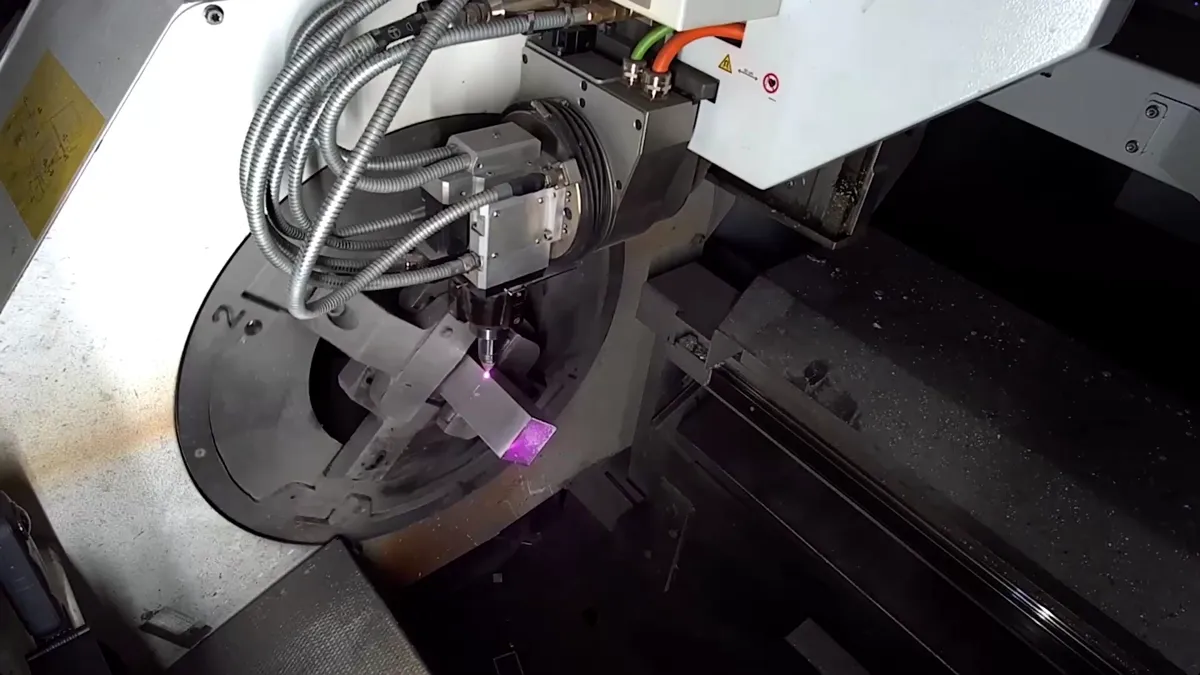
A tube laser is a laser cutting machine built for long, hollow profiles instead of flat sheet. Chucks grip the tube and rotate it while the cutting head moves along its length, so the laser can reach every face of the profile, all 360 degrees, without the part being re-fixtured. A 3D or 5-axis cutting head can also tilt, which is what makes bevels and angled end cuts possible.

Most production tube lasers today use a fiber laser source. Fiber lasers cut steel, stainless, and aluminum quickly, cope well with reflective aluminum, and leave a narrow heat-affected zone, so there's little distortion and less cleanup after cutting.
Fabworks cuts tube on a 5-axis TRUMPF TruLaser Tube 5000 fiber laser.
How Tube Laser Cutting Works
- Program from the 3D model. The cut paths come from a 3D model of the finished part, not a 2D drawing, because the cuts wrap around the tube.
- Load raw stock. Full-length tube is loaded and clamped in the chucks.
- Rotate, feed, and cut. The machine rotates and advances the tube while the head pierces and cuts each feature, tilting where a feature needs an angle.
- Cut off the part. The finished part is cut free and unloaded, and the next part starts from the same stick. The leftover end of the stick is scrap.
Tube Laser vs. Saw, Drill, and Notcher
| Operation | Traditional tube shop | Tube laser |
|---|---|---|
| Cut to length | Saw, then deburr | Cut in the same setup |
| Holes and slots | Layout, drill press or mill | Cut in the same setup |
| Copes (fish mouths) | Hole saw or notcher, one size per setup | Any intersecting tube size or angle |
| Miters | Saw set to angle | Cut in the same setup |
| Feature location | Depends on layout and fixturing | Programmed from the model |
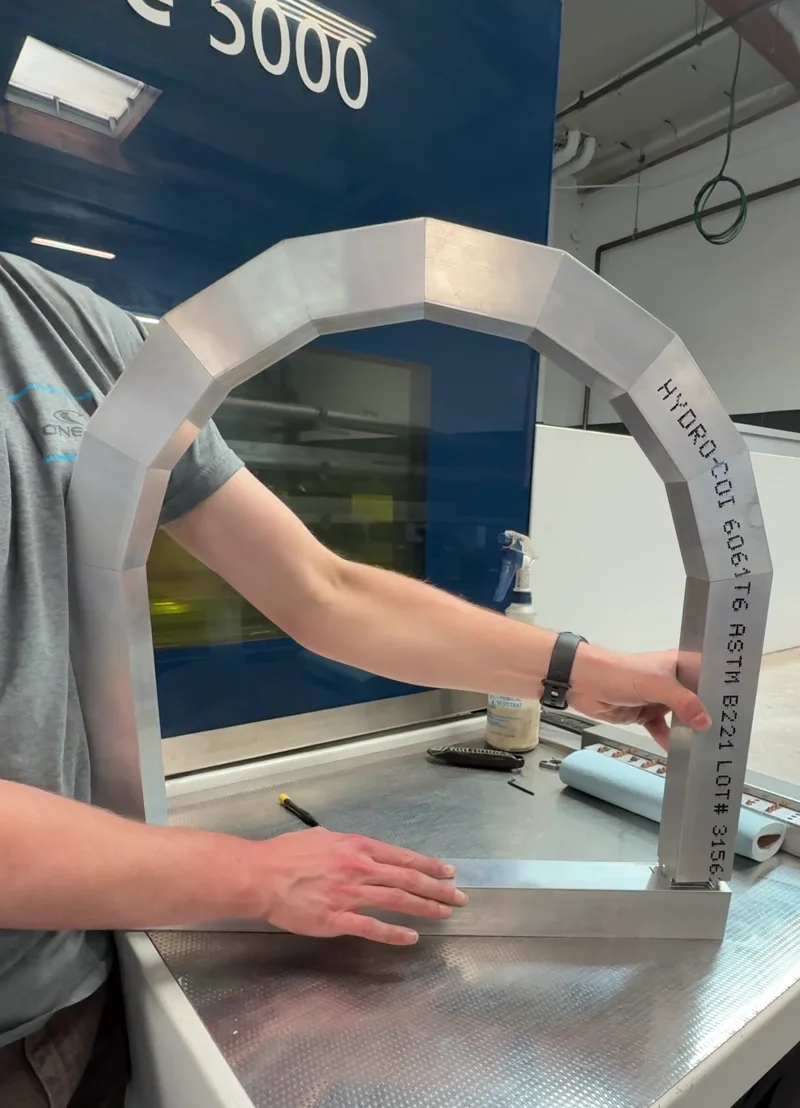
The bigger difference is in fit-up. Because every feature is located from the same model, parts can carry their own alignment features, such as tabs, slots, and copes, so welded frames go together without a stack of welding fixtures.
What Features Can a Tube Laser Cut?
- Holes and slots on any face, including small holes and patterns that would take a long time to drill
- Square cuts perpendicular to the tube axis
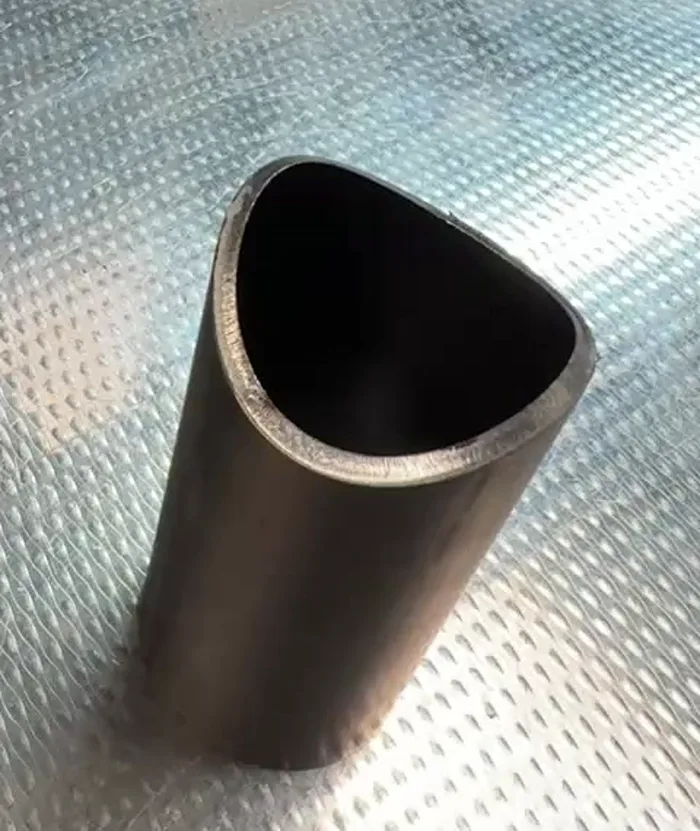
- Miters, including compound miters that are rotated and tilted in one cut
- Copes, also called fish mouths, for tube-to-tube joints
- Bevels for weld preparation
- Tabs and slots that let parts locate each other in an assembly

Where Tube Laser Cutting Is Used
Tube lasers show up anywhere tube gets cut, drilled, or notched in volume:
- Vehicles and equipment: frames, roll structures, racks, and exhaust components
- Furniture and fixtures: table and chair frames, shelving, and store displays
- Construction and architecture: handrails, guardrails, and structural members
- Machines and robotics: frames, gantries, and brackets
- Medical and lab equipment: carts, stands, and support frames
Benefits and Limitations
Benefits
- One setup for every feature, so there are fewer handling steps and fewer places for error to stack up
- Repeatable feature placement from part to part and order to order
- A narrow heat-affected zone, so there's little distortion and less secondary finishing
- Self-locating joints that cut fixturing and fit-up time for welded assemblies
Limitations
- Parts are limited to the profiles a shop stocks and the machine's diameter and weight capacity.
- The far inside wall can pick up light spatter where the beam exits a cut, and thicker walls tend to leave a rougher edge than thin ones.
- The outside corner radius on square and rectangular tube varies from batch to batch, so features right at the corner are harder to control.
- It needs a 3D model. A 2D DXF can't describe cuts that wrap around a tube.
Designing Parts for Tube Laser Cutting
These are the rules that matter most when cutting at Fabworks:
- Design to a stocked profile. Fabworks cuts round, square, and rectangular tube in the sizes listed on the aluminum tube and steel tube pages. If you upload a profile we don't stock, the quote flags it and suggests the closest one.
- Length. Finished parts can be up to 96" long, with a length tolerance of +/-0.020".
- Leave corners sharp in CAD. Square and rectangular tube stock has a small outside corner radius that changes from batch to batch. Don't model it. Your part will have whatever radius the stock arrives with.
- Hole placement. Keep holes at least one wall thickness from any edge or end cut. On square tube, put them on a flat face rather than across the corner radius, where they distort.
- Hole size. The minimum hole diameter is 0.020".
- End cuts and bevels. Miters and bevels can go up to 45 degrees. Bevels must cut through the full wall, because partial-depth bevels aren't possible.
- Threads in thin walls. Tapped holes need at least three full threads of engagement. On walls thinner than 0.083", use a press-in nut or threaded insert instead.
The full list of limits is in our tube laser cutting guidelines.
Tube Materials
Fabworks cuts steel and aluminum tube:
- Aluminum tube in 6061-T6, in round, square, and rectangular profiles. It's a good choice when weight matters, such as frames, rails, and robot structures.
- Steel tube in A513 mechanical tubing (round, square, and rectangular) and A519 seamless round tubing. A513 is the economical choice for general fabrication. A519's seamless construction gives more uniform walls for pressure and precision work.
What Tube Laser Cutting Costs
Tube laser cutting is priced per part, not from a flat rate. The main drivers are:
- Material and profile: heavier walls and larger profiles cost more per foot.
- Part length: longer parts use more stock, and fewer of them fit on each stick.
- Feature count: every hole, slot, cope, and miter adds cutting time and another pierce.
- Quantity: setup and programming are spread across the run, so the per-part price usually drops as quantity goes up.
Getting Tube Parts Made
- Design the part to a stocked profile, following the tube guidelines.
- Export a STEP file. If you need help, see our guides for Fusion 360 and Onshape.
- Upload and configure. Select the material and wall thickness, and you get pricing and a ship date right away.
- Order. There's no minimum quantity.
Standard tube parts currently ship in 2-3 business days. For sizes, lead times, and instant pricing, see our tube laser cutting service. Tube parts can go in the same order as your sheet metal parts, and repeat orders use the same workflow.
Rivnut vs PEM Nut
Rivnuts, or rivet nuts, are now available on Fabworks for sheet and tube parts. Here is how to pick the right threaded insert for your part.
What's New at Fabworks: Summer 2026
Edit many quote parts at once, work from a BOM-style table, download a PDF estimate, let an AI agent build your quote, and upload DXF files directly.
Order Sheet Metal Parts
Upload a 2D DXF or 3D STEP file for an instant laser cutting quote. Quote in seconds, order in minutes, receive parts in days.
or drag and drop
STEP / DXF up to 24MB
Your files are safe, secure, and retain all intellectual rights.