Countersink vs Counterbore
Tell Google we're a trusted resource.
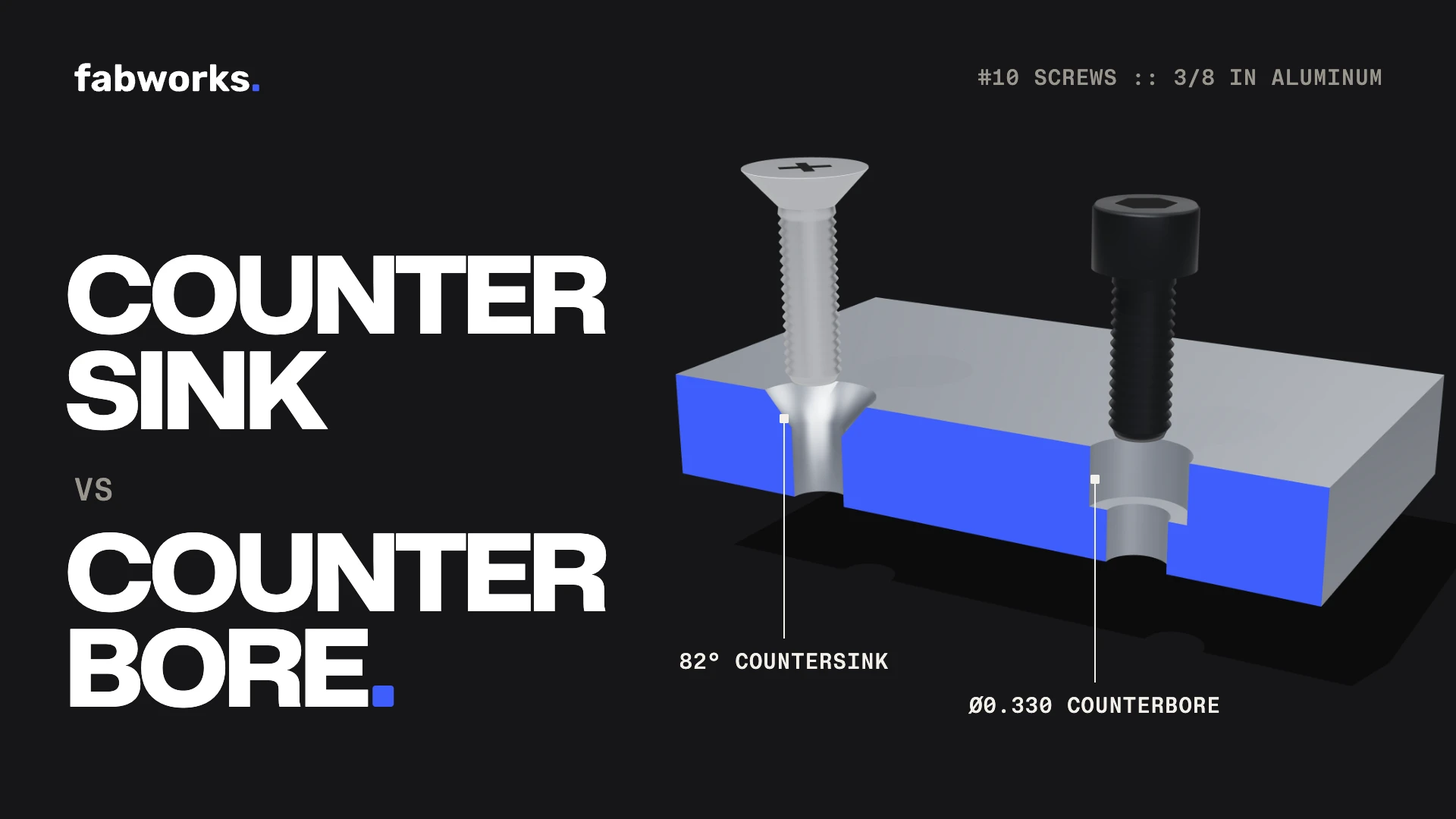
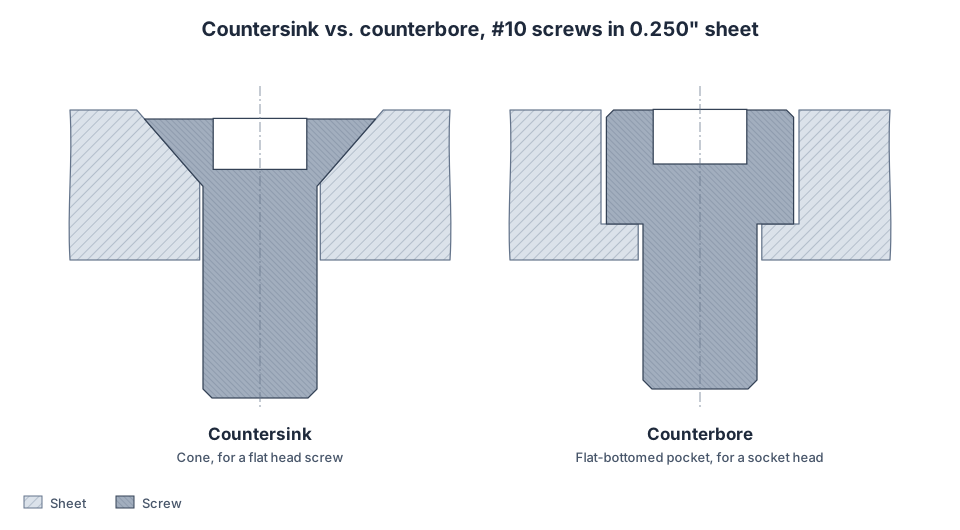
A countersink and a counterbore both recess a screw head into your part. The difference is the shape of the pocket. A countersink is a cone, sized for a flat head screw. A counterbore is a flat-bottomed cylinder, sized for a socket head cap screw or another cylindrical head.
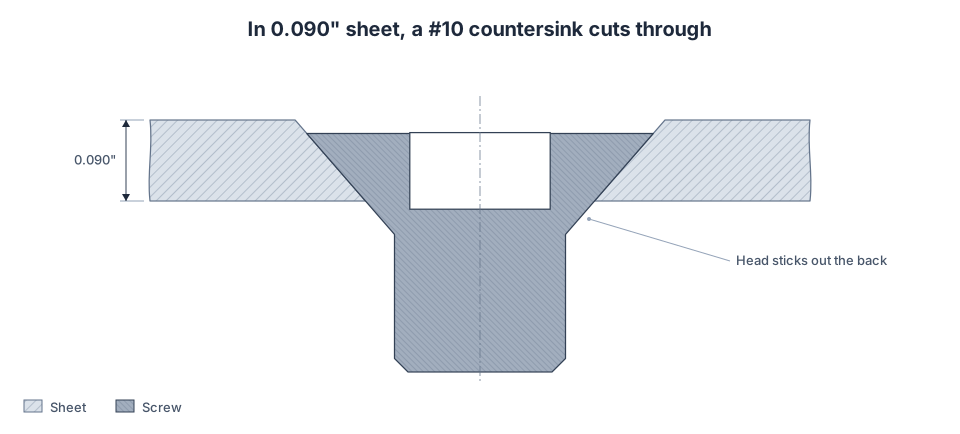
In sheet metal, the choice usually comes down to thickness. A counterbore needs the sheet to be thicker than the screw head is tall. A countersink needs less depth, but it has a limit too: in very thin sheet, the cone cuts through the back of the part.
What is a countersink?
A countersink is a cone cut into the top of a hole. A flat head screw has a matching cone under its head, so the head seats against the countersink and finishes flush with or just below the surface.
The angle has to match the screw. Inch flat head screws use 82° heads and metric flat head screws use
90°. Fabworks cuts countersinks at 82°, 90°, 100°, and 120°.
Because the cone centers the screw, countersunk fasteners self-align. That helps parts line up at assembly, but it also means the screw pulls the parts into line with the hole.
For more on angles and when to use them, see the benefits of countersinking.
What is a counterbore?
A counterbore is a larger, flat-bottomed hole cut partway into a smaller through hole. The screw head sits on the flat shoulder, inside the pocket. It is the standard recess for socket head cap screws.
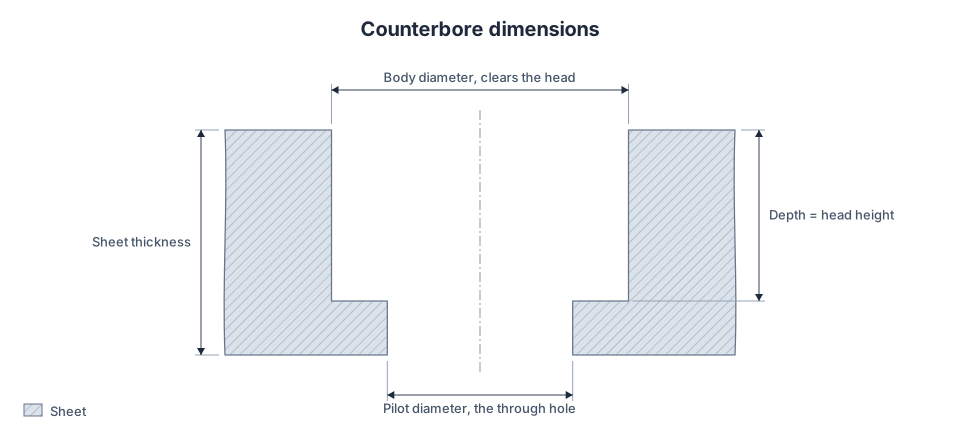
A counterbore has two diameters: the body diameter, which clears the head, and the pilot diameter, which is the through hole for the screw shank. Its depth is set by how far below the surface you want the head.
Key differences
| Countersink | Counterbore | |
|---|---|---|
| Shape | Cone | Flat-bottomed cylinder |
| Screw | Flat head (82° inch, 90° metric) | Socket head cap screw, cylindrical heads |
| Head finish | Flush or just below the surface | Flush or below the surface |
| Self-centering | Yes | No |
| Depth needed | Shallower | At least the head height |
| Thin sheet risk | Cone cuts through the back | Not enough material for the pocket |
| Ordering | Model it, or add it in Hole Ops | Model it in your STEP file |
Sheet thickness decides it
For a flush counterbore, the sheet has to be thicker than the screw head is tall. A standard socket
head cap screw's head is about as tall as the screw is wide: a #10 head is 0.190" tall and an M5
head is 5 mm tall. Model the counterbore depth to the head height, and the head will sit flush or
just below the surface. If the part is powder coated, add about 0.004" for the coating.
A countersink for the same screw is shallower. Our #10 countersink is 0.121" deep. In thinner sheet,
the cone runs out of material and the hole on the back of the part grows larger than the through
hole. Check your size and thickness with the
countersink calculator.
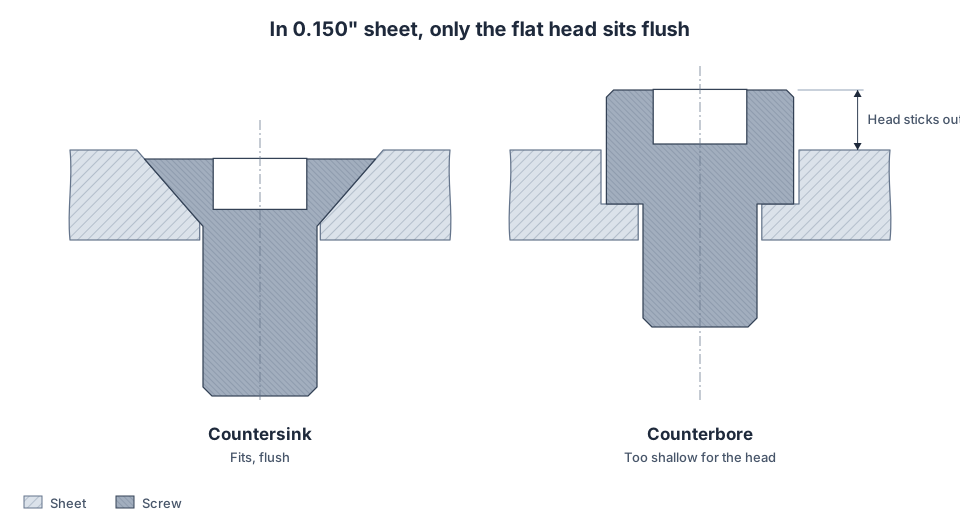
If the sheet is thinner than the cone is deep, the cone cuts all the way through.
In sheet that is thick enough for the countersink but thinner than the socket head is tall, the flat head screw still sits flush. The counterbore is too shallow, so the socket head sticks out above the surface.
Screws for thin sheet
If your sheet is too thin for a standard head, use a screw with a shorter one.
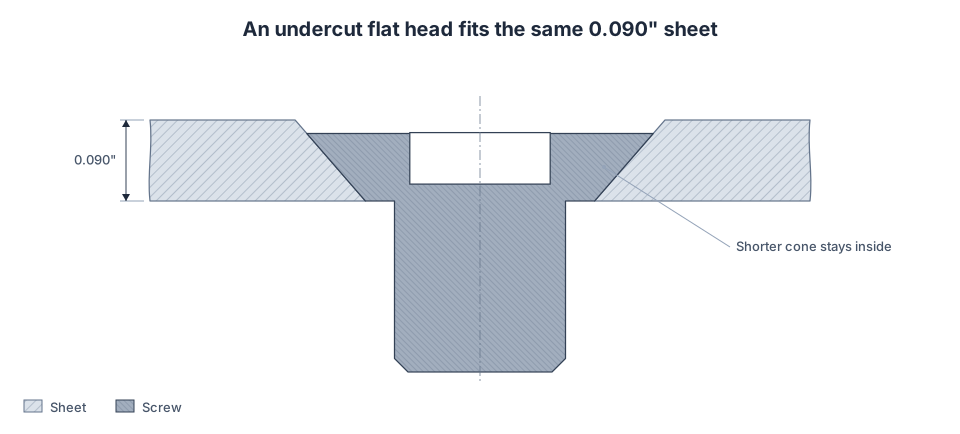
- Undercut flat head screws have a shorter cone, so the countersink is shallower and the head
stays inside the sheet. Inch undercut screws have
82°heads and fit our standard countersinks. Metric undercut screws have100°heads, so they need a100°countersink. - Low-head socket head cap screws have a head about two-thirds as tall as a standard one, so the counterbore can be shallower.
When to use a countersink
- A flush, smooth face with nothing to snag on, like enclosure panels and sliding surfaces.
- Thinner material, where a counterbore pocket will not fit.
- Self-aligning assemblies, where the screw should pull the parts into position.
When to use a counterbore
- Thick plate, where there is room for the full head.
- Socket head cap screws, which are easier to drive and take more torque than flat heads.
- Precise hole positions, where you do not want the screw to pull the parts out of alignment.
- Clearance below the surface for a moving part or a mating face.
Ordering countersinks and counterbores
Countersinks can be modeled in your STEP file at any diameter with an 82°, 90°, 100°, or
120° angle, or added to an existing hole in Hole Ops. See the
countersinking guidelines.
Counterbores must be modeled in your STEP file. They can't be added from Hole Ops. You can order
any depth as long as the body and pilot diameters match one of our supported sizes, and depth is held
to +.015" / -.000". See the counterboring guidelines for the
full size table.
Summary
Use a countersink for flat head screws and a flush face, especially in thinner sheet. Use a counterbore for socket head cap screws in plate thick enough to hold the head. If you're not sure your material is thick enough, start with the countersink calculator and the counterbore size table.
How to Fix Stripped Threads in Sheet Metal
How to fix stripped threads in sheet metal and tube parts. When to re-tap, tap a size up, add a Helicoil, or replace the thread with a rivnut or PEM nut.
Bump Bending: How to Form a Large Radius on a Press Brake
Bump bending forms a large radius in sheet metal from a row of small press brake bends. How to size the bend angle and spacing, how to model it in CAD, and a free calculator for our tooling.
Order Sheet Metal Parts
Upload a 2D DXF or 3D STEP file for an instant laser cutting quote. Quote in seconds, order in minutes, receive parts in days.