Sheet Metal Fasteners: How to Choose the Right Hardware
Tell Google we're a trusted resource.
Sheet metal is usually too thin to hold a useful thread. A 6-32 screw in 0.060" aluminum gets barely two threads of engagement, and they strip long before the screw is tight. Sheet metal fasteners fix that. Self-clinching hardware, often called clinch nuts or PEM hardware, is pressed into the sheet, and rivet nuts are set from one side, so the threads come from the fastener instead of the material.
Fabworks installs six kinds of sheet metal fasteners: PEM nuts, PEM flush nuts, PEM studs, PEM standoffs, PEM blind standoffs, and rivnuts. This guide walks through how to pick between them for a given part. It comes down to four questions:
- What does the mating part need: a threaded hole, a threaded post, or a gap?
- Can the press reach both sides of the hole?
- Does either face of the sheet need to stay flat?
- What material and thickness is the part?
Start with what's attaching to the part
The first question decides most of the answer. Think about the part or component that bolts on, and what the assembly looks like from its side.
- A screw goes through the other part into yours. You need an internal thread on your part. Use a PEM nut, a flush nut, or a rivnut.
- The other part slides over a threaded post and a nut holds it. You need an external thread. Use a PEM stud.
- The other part needs to sit at a fixed height above yours, like a circuit board, a cover, or a second panel. Use a standoff or blind standoff.
The other three questions then narrow it to one option.
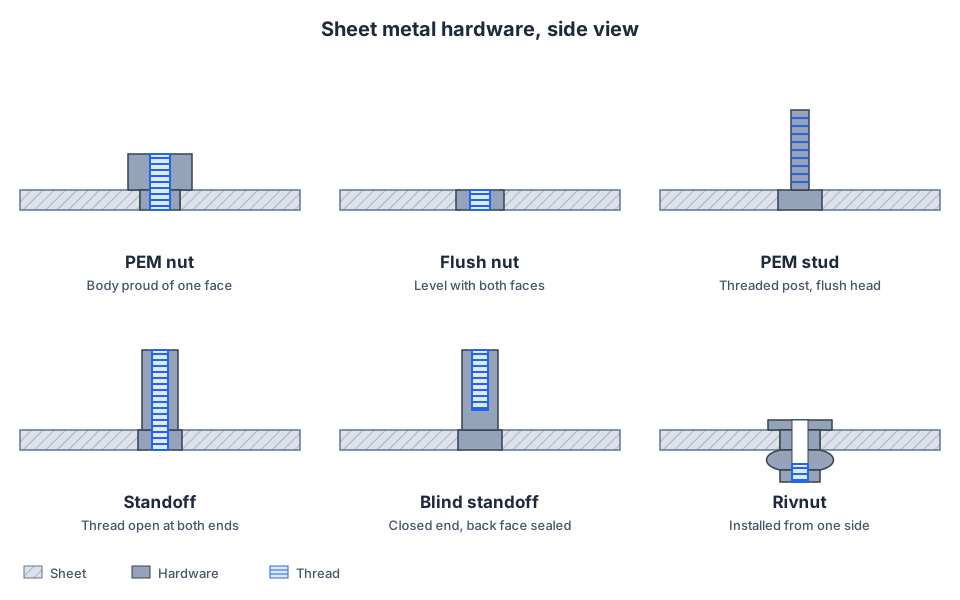
Sheet metal fastener decision table
| Use | When you need | Works on |
|---|---|---|
| PEM nut | A threaded hole, both sides reachable | Sheet |
| PEM flush nut | A threaded hole, nothing proud of either face | Sheet |
| Rivnut | A threaded hole, back side unreachable | Sheet and tube |
| PEM stud | A threaded post sticking out of the sheet | Sheet |
| PEM standoff | A spacer with a through thread | Sheet |
| PEM blind standoff | A spacer with a closed end | Sheet |
| Tapping | A thread in thicker material, no extra part | Sheet and tube |
PEM nuts
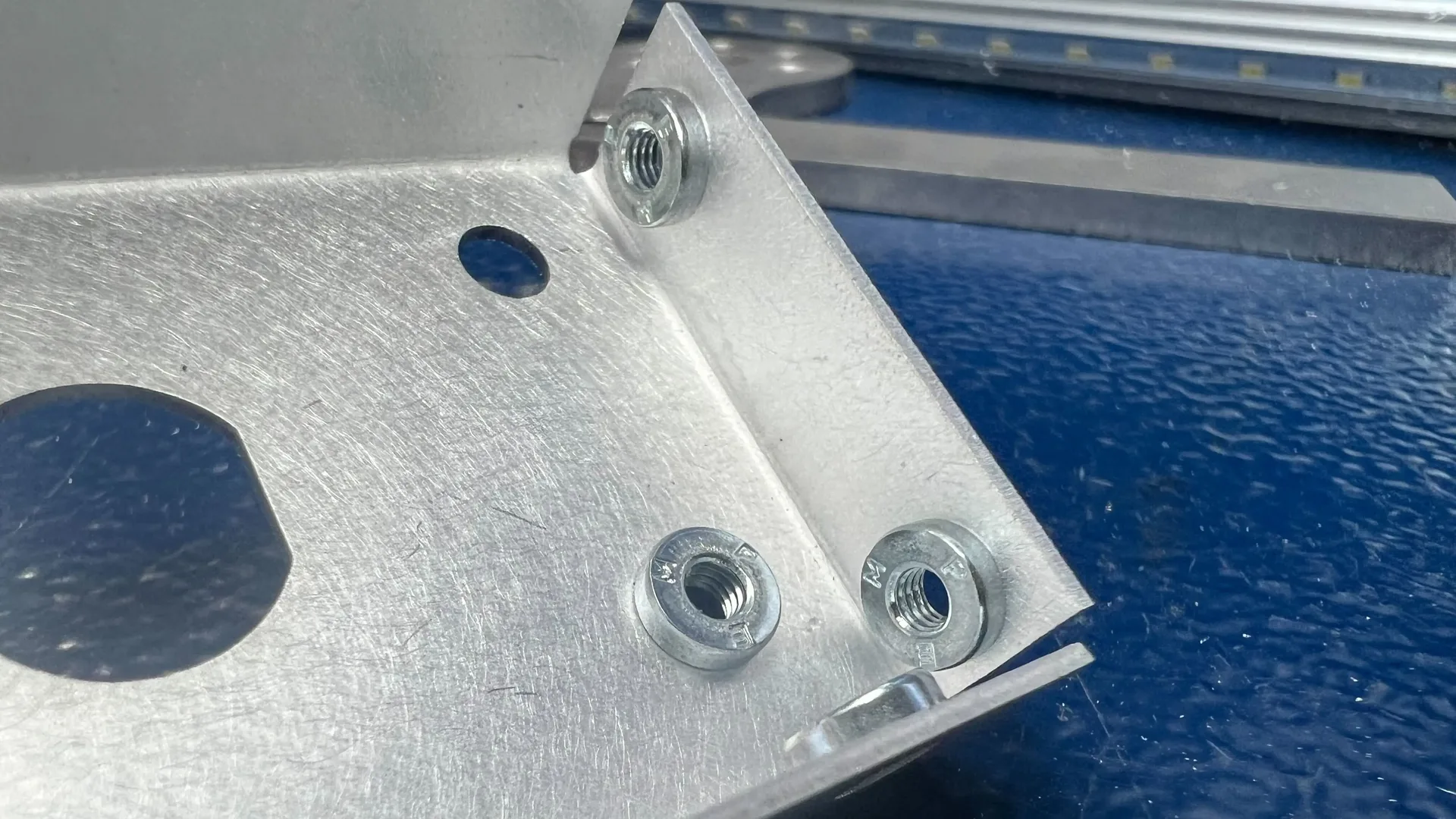
A PEM nut, also called a self-clinching nut or clinch nut, is the default threaded insert for sheet metal. It goes into a laser-cut hole, and a press squeezes it until its knurled collar displaces sheet into an undercut on the nut. The sheet locks it in place, and it won't spin when you torque a screw into it.
The nut's body sits proud of one face of the sheet, and its shank ends flush with the other face. Leave clearance for the body on that side.
Use a PEM nut when:
- you need a threaded hole in flat or bent sheet and both faces of the hole are reachable
- the screw will be removed and re-installed during service, so you want threads that don't wear out the sheet
- the sheet is too thin to tap
Sizes: #2-56, #4-40, #6-32, #8-32, #10-24, #10-32, 1/4-20, M2, M3, M4, M5, and M6.
Materials: Aluminum, steel, and galvanized steel parts get zinc-plated steel nuts. Stainless parts get hardened stainless nuts, available in every size except M2.
PEM flush nuts
A flush nut does the same job as a PEM nut, but it finishes level with the sheet instead of leaving a body proud of one face. It only sits flush on both faces when the sheet is at least as thick as the nut, which is 0.060" for most sizes. In thinner sheet it stands proud of the back. Use it when something has to lie flat against the back of the panel: a sliding cover, a label, a gasket, or a second sheet stacked directly behind.
The trade-off is thread length. A flush nut is shorter than a standard nut of the same thread: 0.060" against 0.090" for #10-32, and 0.120" against 0.170" for 1/4-20. Fewer threads means less strength, so if neither face needs to stay flat, use a standard nut.
Sizes: #4-40, #6-32, #8-32, #10-32, 1/4-20, M2, M3, M4, M5, and M6. The 1/4-20 and M6 flush nuts need sheet at least 0.119" thick.
Materials: Aluminum, steel, and galvanized steel only. Flush nuts are not available on stainless steel parts. On stainless, use a standard PEM nut, or a rivnut if the back side is out of reach.
PEM studs
A PEM stud is a threaded bolt pressed permanently into the sheet with its head flush on the back face. The threaded post sticks out of the front.
Studs are the right pick when the other part has clearance holes and you want to hang it on posts and run nuts down from one side. That makes them good for:
- One-person assembly. The studs hold the mating panel in place while you start the nuts, so you don't need a hand behind the sheet.
- Locating parts. The studs line the mating part up for you.
- Grounding lugs and brackets that slide onto a post.
- Sealed or cosmetic faces. The head on the back is flush, so the back face stays clean.
Pick a length that leaves at least a few threads past the nut once everything is stacked on. Add up the thickness of the mating part, any washers, and the nut height.
Sizes and lengths:
| Thread | Lengths available |
|---|---|
| #4-40 | 0.250" to 0.625" |
| #6-32 | 0.250" to 0.625" |
| #8-32 | 0.250" to 0.625" |
| #10-32 | 0.375" to 0.750" |
| 1/4-20 | 0.375" to 1.000" |
| M3 | 6 mm to 18 mm |
| M4 | 6 mm to 35 mm |
| M5 | 8 mm to 20 mm |
| M6 | 12 mm to 25 mm |
| M8 | 12 mm to 35 mm |
Materials: Aluminum, steel, and galvanized steel parts get zinc-plated steel studs, and stainless parts get stainless studs. M8 studs are only available on aluminum, steel, and galvanized steel, in sheet at least 0.095" thick.
PEM standoffs
A standoff, or self-clinching standoff, is a threaded spacer pressed into the sheet. It holds a second part at a set height, with a screw coming down through that part into the standoff.
The classic use is mounting a circuit board inside an enclosure. Standoffs are also used for spacing covers and display panels off a chassis, leaving room for wiring or airflow behind a panel, and stacking parallel plates.
A through-threaded standoff (SO) is open at both ends, so the screw can pass all the way through and out the back of your sheet. That makes it more forgiving of screw length. Use a blind standoff when that's a problem.
Sizes and heights:
| Thread | Heights available |
|---|---|
| #4-40 | 0.312" to 0.500" |
| #6-32 | 0.312" to 0.625" |
| #8-32 | 0.312" to 0.500" |
| #10-32 | 0.312" to 0.500" |
| M3 | 4 mm to 12 mm |
| M4 | 6 mm to 25 mm |
| M5 | 6 mm to 12 mm |
Materials: Zinc-plated steel standoffs for aluminum, steel, and galvanized steel parts, and stainless standoffs for stainless parts.
PEM blind standoffs
A blind standoff (BSO) is the same spacer with a closed end. The thread stops inside the body, so the screw can never come out the back of your sheet.
Use a blind standoff when:
- the back face is a cosmetic or customer-facing surface and can't have a hole in it
- the back of the panel needs to stay sealed against dust or water
- a long screw would hit a wire, a component, or another part behind the sheet
Because the thread is closed, the screw length matters. Pick a screw short enough that its head seats before its tip reaches the end of the thread.
Sizes and heights:
| Thread | Heights available |
|---|---|
| #4-40 | 0.312" to 0.500" |
| #6-32 | 0.312" to 0.625" |
| #8-32 | 0.312" to 0.500" |
| #10-32 | 0.312" to 0.500" |
| M3 | 6 mm to 25 mm |
| M4 | 6 mm to 25 mm |
| M5 | 6 mm to 12 mm |
Materials: Zinc-plated steel for aluminum, steel, and galvanized steel parts, and stainless for stainless parts.
Rivnuts
Every PEM part above needs a press on both sides of the hole. A rivnut, also called a rivet nut or blind rivet nut, does not. It goes in from the front, and a tool pulls its threads toward the installer until the back of the body bulges into a flange behind the sheet. Everything happens from one side.
That makes the rivnut the answer for:
- Tube parts. There is no way to get a press inside a closed tube. Rivnuts and taps are the only options on tube, and rivnuts go in from the outside face.
- Closed or boxed parts where the back of the hole can't be reached.
- Thicker sheet with pull-out loads. A rivnut clamps the sheet between its head and the bulged back, so it tends to hold harder on pull-out as the sheet gets thicker.
Rivnuts have two drawbacks. The head sits proud of the front face, and each rivnut only sets correctly in a band of sheet thickness called its grip range. Fabworks picks the right grip range for your material thickness automatically.
Sizes: #6-32, #8-32, #10-24, #10-32, 1/4-20, 5/16-18, 3/8-16, M4, M5, M6, M8, and M10. The smallest sizes work in sheet from 0.020" thick, and the largest reach 0.312".
Materials: Rivnuts are available on aluminum, steel, galvanized steel, and stainless parts, on both sheet and tube (steel and aluminum).
For a deeper comparison, see Rivnut vs PEM Nut.
When to tap instead
Hardware is not always the answer. In thicker sheet, a tapped hole gives a perfectly good thread without any extra part. Tapping needs no extra part and leaves nothing sticking out of either face.
A rule of thumb is to aim for about three full threads of engagement. In thin sheet you won't get that from a tap, so use hardware. Tapping vs PEM goes through the trade-off in detail, and the tapping guidelines list the thicknesses each tap supports.
Material and thickness checks
Once you've picked a type, check it against your part's material:
- Stainless steel: no flush nuts, no M2 nuts, and no M8 studs. Every other type and size is available, in stainless hardware.
- Aluminum, steel, and galvanized steel: every type and size is available.
- Tube: rivnuts and taps only.
- Thick and thin sheet: a few sizes have a minimum thickness, like the 1/4-20 and M6 flush nuts and the M8 studs. Rivnuts must match their grip range. The quote checks each hole against the listed thickness range for its hardware.
- Heavy parts: hardware, tapping, and countersinking are not available on parts over 80 lbs.
Hardware adds about one business day to lead time. The ship date shown at checkout already includes it.
Choosing a thread size
If the mating part already sets the screw size, such as a circuit board with M3 mounting holes or a bracket with 1/4" clearance holes, match it.
If you're choosing from scratch:
- #4-40 / M3: electronics, circuit boards, small covers, light panels
- #6-32 / #8-32 / M4: general enclosure hardware, access panels, small brackets
- #10-32 / #10-24 / M5: heavier brackets, rack equipment, mounting parts that take real load
- 1/4-20 / M6 and up: structural brackets, frames, machine parts, tube assemblies
Keep a part to one or two thread sizes where you can. Fewer sizes means fewer screws, drivers, and chances to grab the wrong one during assembly.
Placing hardware
A few placement habits prevent most problems:
- Draw a plain round hole where the hardware goes and pick the hardware on the part in the quote. Fabworks resizes the hole for whatever you choose. Don't model threads into the hole.
- Leave room around the hole. PEM hardware needs material around its collar to clinch into, and rivnuts need a flat face for the head to seat on. Keep hardware clear of edges, cutouts, and bend lines. Each hardware row in the hardware guidelines lists its hole size and outer diameter for spacing.
- Hardware goes in after bending. Leave enough space around each piece of PEM hardware for the press to reach both sides of the hole on the finished part. A hole deep inside a narrow channel may be hard to reach.
- Mind which side it goes on. Studs and standoffs stick out of one face, and standard nuts sit proud of one face. Make sure the quote preview shows each one on the side your model expects.
FAQ
What is the difference between a PEM nut and a rivet nut?
A PEM nut is pressed into the sheet, so the press needs to reach both sides of the hole. A rivet nut (rivnut) is set from the front with a tool that collapses its body behind the sheet, so it only needs one side. Use a PEM nut on flat or bent sheet you can reach from both sides, and a rivnut on tube or closed parts. Rivnut vs PEM Nut covers the trade-offs.
Is a clinch nut the same as a PEM nut?
Yes. PEM is a brand of self-clinching fasteners, and "clinch nut" and "self-clinching nut" are the generic names. All three describe a nut that locks into the sheet when a press pushes it into a sized hole.
What is the minimum sheet thickness for sheet metal fasteners?
It depends on the fastener. Flush nuts need sheet at least as thick as the nut to finish flush, about 0.060" for most sizes and 0.119" for 1/4-20 and M6. M8 studs need 0.095" or more. Rivnuts start at 0.020" in the small sizes. The quote checks each hole against the listed thickness range for its hardware.
Can you install PEM hardware in stainless steel?
Yes. Stainless parts get stainless PEM nuts, studs, standoffs, and blind standoffs, and stainless rivnuts. Flush nuts, M2 nuts, and M8 studs are the exceptions.
Can you put hardware in tube parts?
Only rivnuts and taps. There is no way to press PEM hardware from inside a closed tube, so rivnuts are installed from the outside face.
Adding hardware to your quote
You have two ways to add hardware:
- Automatically from your CAD model. Model PEM hardware in your assembly, name each body with its part number, and export a multi-body STEP. Fabworks matches each body to the right hole. See How to Auto-Add PEM Hardware.
- Manually in the quote. Click a hole, filter by hardware type, and pick the size. This is also how rivnuts are added.
Every size, hole diameter, and part number Fabworks stocks is listed on the hardware guidelines page, and the hardware insertion service page covers pricing and lead times. If you're unsure which option fits your part, upload it and ask our support team. They're happy to help.
Order Sheet Metal Parts
Upload a 2D DXF or 3D STEP file for an instant laser cutting quote. Quote in seconds, order in minutes, receive parts in days.
or drag and drop
STEP / DXF up to 24MB
Your files are safe, secure, and retain all intellectual rights.