The Machines That Make Your Parts
Tell Google we're a trusted resource.
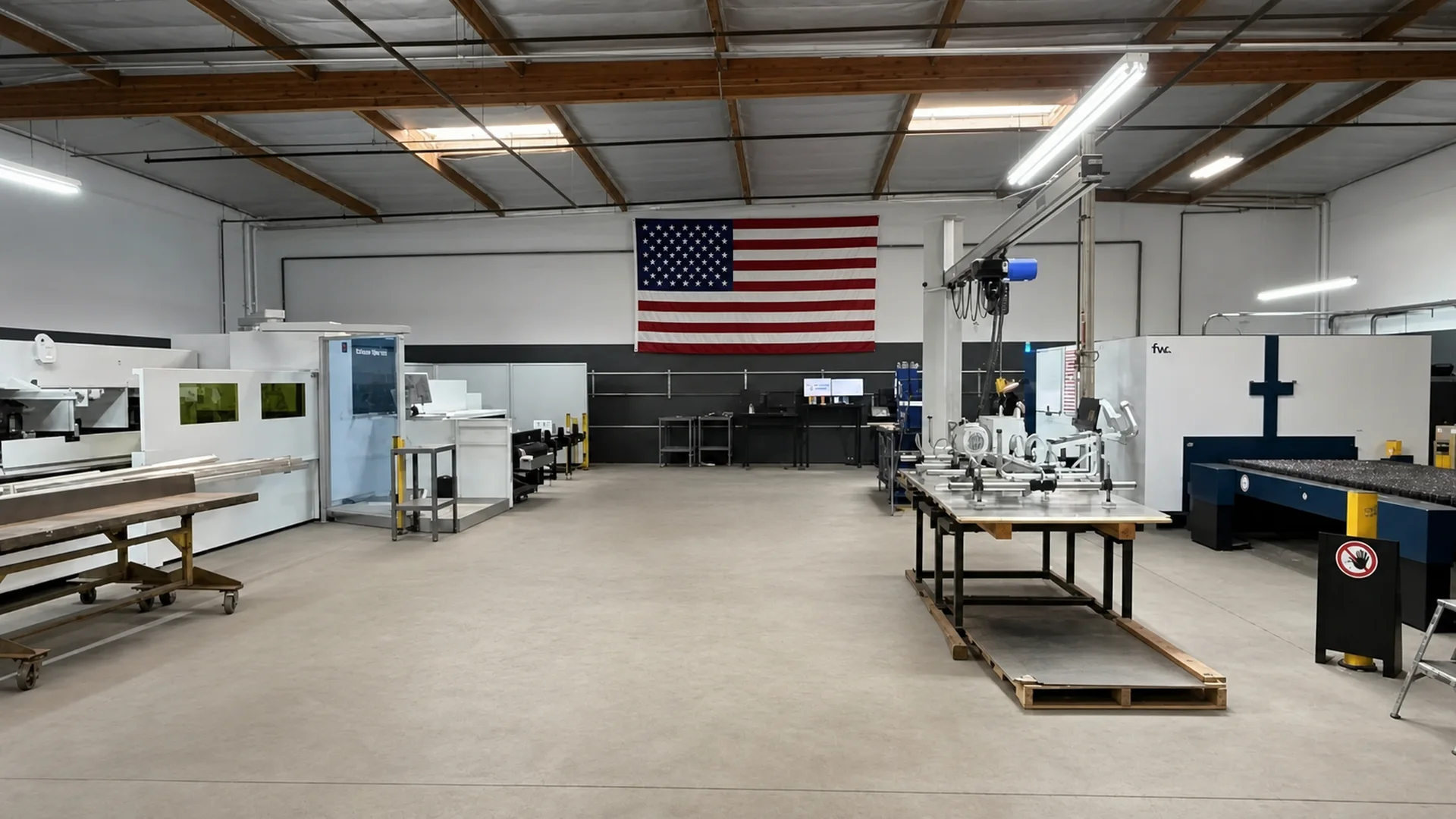
Upload a STEP file to Fabworks (need one? see the Fusion 360 or Onshape export guide) and the 3D model becomes an instant quote. But the part still has to be made by real machines, in a real shop in Ventura, California. Here is a quick look inside, followed by a tour of that shop: the equipment a part moves through, what each machine can do, and where it fits between an uploaded file and a finished part.
Watch custom parts move through Fabworks laser cutting, deburring, press brake bending, and in-house hole operations in Ventura, California.
Video transcript
This is where all your custom parts get made. Every job starts at the lasers. Flat parts run on our 4 kW or 10 kW flatbed. Tube runs on the 5-axis tube laser. Next, deburring. Every edge gets cleaned up so your parts are smooth and safe to handle. Then the bending department. Our press brakes run 40 to 80 tons, thin gauge to 1/4-inch plate. Last stop, hole operations. Hardware, tapping, and countersinking, all in-house. All under one roof in Ventura, California. Upload your file at fabworks.com, and this whole shop gets to work.
The Lasers
Every job starts here. Flat sheet parts and tube parts each run on a dedicated fiber laser.
Sheet metal laser cutting runs on a 4 kW TRUMPF TruLaser 1030 or a 10 kW TRUMPF TruLaser 5030, which cut the part profile, slots, holes, tabs, and other 2D features directly from the uploaded STEP model. See our new laser post for more on how jobs are routed between the two.
- Part size: 0.25" x 0.25" up to 96" x 47", no minimum order quantity
- Cutting tolerance: +/-0.005" on most parts, tighter on simple holes and slots
Tube laser cutting runs on a 5-axis TRUMPF TruLaser Tube 5000, which can cut holes, slots, tabs, copes, miters, bevels, and end features into round, square, or rectangular tube.
- Finished length: up to 96"
- Cutting tolerance: +/-0.005" on most parts
Neither machine needs kerf compensation in your CAD file. The CAM workflow accounts for the laser cut automatically, so the part that comes off the laser matches the uploaded model within tolerance.
Deburring
After cutting, sheet parts move to deburring, where sharp edges, tabs, and small burrs left by the laser get cleaned up.
It is a small step with a real effect: deburred edges are smoother to handle, safer for whoever assembles the part, and more appropriate for anything customer-facing. Fabworks defaults most parts to deburring for that reason, but it can be turned off for prototypes where speed or cost matters more than edge finish.
The Press Brakes
Sheet parts with bends move to sheet metal bending next, on one of two machines.
The TRUMPF TruBend 7050 is the primary brake, running up to 40 tons. Its back gauge moves independently on every axis, so it can set two different flange lengths at two different heights on the same part in a single setup. The Amada HD-8025NT is the second brake, running up to 88 tons with about 8 feet of bending length, for longer parts where both sides of the gauge can share the same depth and height.
- Material thickness: 0.030" to 0.250"
- Maximum bend length: up to 96", depending on material and thickness
- Bend tolerance: +/-1 degree on angle, +/-0.015" on single-bend formed dimensions
Together they cover most brackets, enclosures, panels, tabs, mounts, and other formed sheet metal parts: asymmetric parts go on the TruBend, longer straightforward parts go on the Amada. Bending is also where geometry gets tested against physics: material thickness, bend radius, and flange length all determine whether a part forms cleanly, and features placed too close to a bend line can distort as the material stretches. The bending guidelines cover this in more detail.
Hole Operations
Many parts finish with one or more hole operations, turning a plain cut hole into a functional mounting point.
- Tapping cuts internal threads directly into a hole.
- Hardware insertion presses in PEM nuts, studs, standoffs, blind standoffs, flush nuts, rivnuts, and related fasteners.
- Countersinking shapes a hole so a flat-head fastener sits flush with the surface, in 82, 90, 100, or 120 degree angles.
These run in-house alongside cutting and bending, so a part that needs threads, hardware, or flush fasteners does not have to leave Fabworks for secondary work.
One Shop, One Order
That is the shop: two fiber lasers, deburring, press brakes, and in-house hole operations, all under one roof in Ventura. A single STEP file can move through any combination of them in one order, which is what makes online fabrication useful for hardware teams, product designers, robotics teams, repair shops, and anyone else who needs custom parts without a slow quote cycle.
Lead time depends on what the order needs. Laser-cut sheet parts are typically the fastest path, while bending, powder coating, hardware, tapping, countersinking, larger quantities, and more complex orders can add time. The ship date shown at checkout reflects the exact services selected for that quote.
Ready to see it work on your part? Upload a STEP file for an instant quote, or read the Fabworks order guide for the full step-by-step ordering process.
Faster Cuts: Our New 10kW Laser Is Online
Fabworks added a second fiber laser, a 10kW TRUMPF TruLaser 5030, that cuts up to 2.5x faster than our original 4kW machine, with the same part size and tolerance.
SendCutSend Alternatives: A Buyer's Guide for 2026
An honest comparison of SendCutSend alternatives with instant online quoting for laser cut sheet metal, including Fabworks, OSH Cut, Xometry, and Ponoko.
Order Sheet Metal Parts
Upload a 2D DXF or 3D STEP file for an instant laser cutting quote. Quote in seconds, order in minutes, receive parts in days.
or drag and drop
STEP / DXF up to 24MB
Your files are safe, secure, and retain all intellectual rights.