Aluminum vs Steel: Is Aluminum Stronger Than Steel?
Tell Google we're a trusted resource.
Is aluminum stronger than steel? Not for the same size part. Steel is about three times as stiff and, grade for grade, usually stronger. Pound for pound, though, aluminum wins: it weighs about a third as much as steel, so an aluminum part of the same weight can be thicker, stiffer, and stronger. Some aluminum alloys, like 7075-T6, are also stronger outright than mild steel.
The right choice depends on which of those matters for your part. Below is a side-by-side comparison of the aluminum and steel grades we stock, followed by the tradeoffs in weight, stiffness, cost, corrosion, and fabrication.
Aluminum vs Steel at a Glance
| Aluminum | Mild steel | Stainless steel | |
|---|---|---|---|
| Weight | About ⅓ of steel | About 3× aluminum | Slightly heavier than mild steel |
| Strength | Low to very high, depending on alloy and temper | Moderate | Moderate yield, high tensile strength |
| Stiffness | About ⅓ of steel | High | High |
| Corrosion resistance | Good; forms its own protective oxide | Poor; needs paint, powder coat, or zinc | Very good |
| Cost per part | Moderate | Lowest | Highest |
| Forming | Easy in soft tempers; heat-treated tempers crack | Easy | Good, but needs more force and springs back |
| Welding | Needs more skill and cleaner prep | Easiest | Moderate; prone to heat distortion |
| Magnetic | No | Yes | 304: essentially no when annealed |
Comparing Aluminum and Steel: What Sets Them Apart?
These two metals are very different compositionally. Aluminum alloys are mostly aluminum, with small additions that set their properties: 5052 is alloyed mainly with magnesium, 6061 with magnesium and silicon, and 7075 with zinc. Steel is mainly a combination of iron and carbon, and stainless steel adds at least 10.5% chromium.
There are many grades of each, each suited to different applications. Fabworks stocks three aluminum alloys in sheet: 5052-H32, 6061-T6, and 7075-T6.
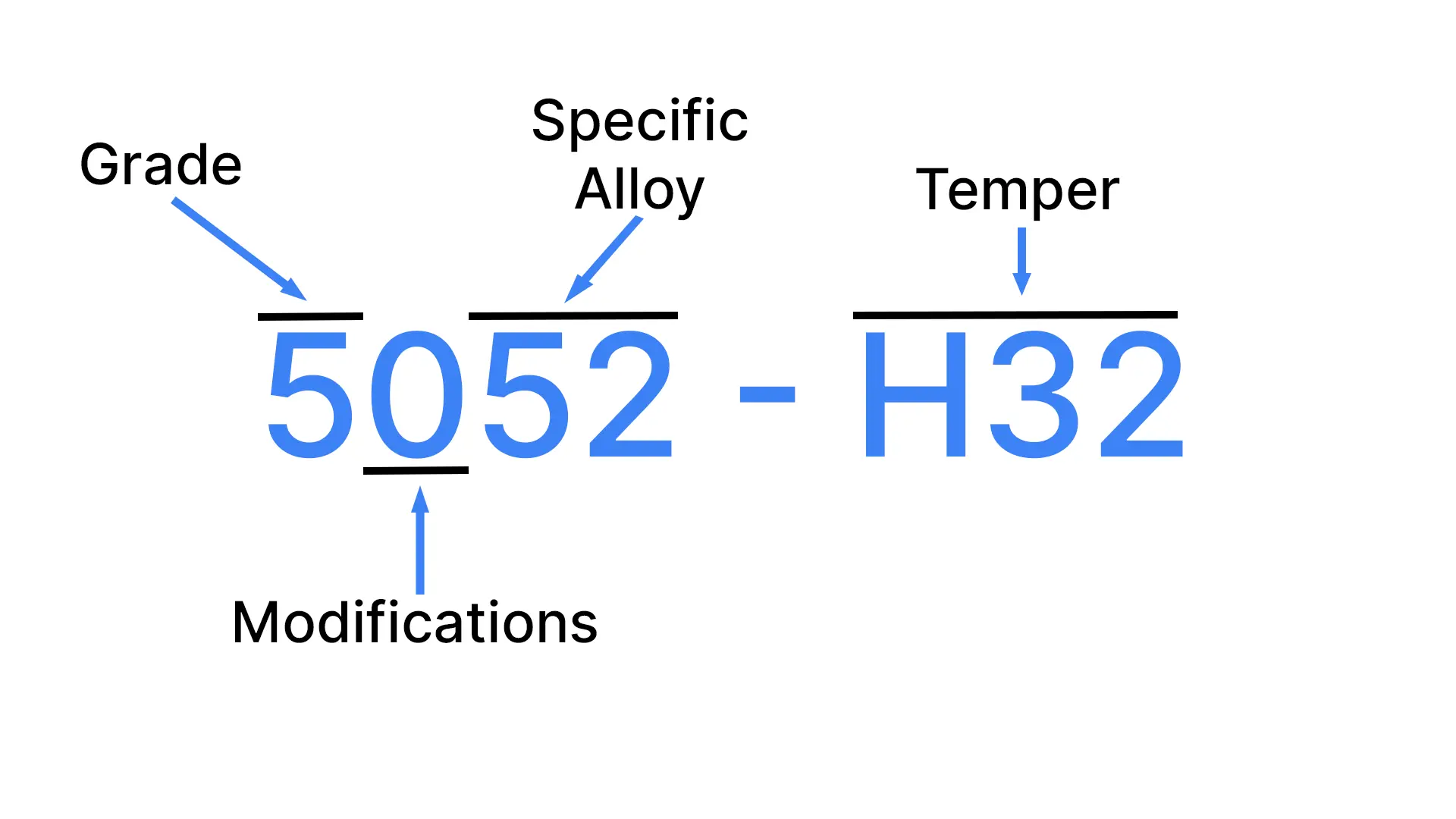
The first digit in an aluminum alloy name is its series, which identifies the main alloying element. The second digit indicates modifications to the original alloy, and is 0 if there are none. The last two digits identify the specific alloy within the series. The part after the dash is the temper. T6 means the aluminum was solution heat-treated, heated high enough to dissolve the alloying elements, and then artificially aged for added strength and hardness. 5xxx alloys like 5052 can't be strengthened by heat treatment, so they are strain hardened instead. The H32 temper is strain hardened and then stabilized with a low-temperature heat treatment.
Steel comes in far more combinations, which can make it hard to choose from if you don't know what you need. Fabworks stocks 1008 cold-rolled and A36 hot-rolled pickled and oiled steel for their wide range of uses, plus G90 galvanized steel and 304-2B stainless steel.
1008 steel is great where extreme strength isn't the priority. It's very easy to form and weld. A36 steel has a higher yield and tensile strength than 1008, while still welding and forming well.
Strength and Strength-to-Weight Ratio
The table below compares typical properties for the grades we stock. Aluminum values are typical for the alloy and temper. A36 and 304 values are specification minimums, so real material usually tests higher.
| Material | Yield strength | Density | Strength-to-weight vs A36 | Stiffness (elastic modulus) |
|---|---|---|---|---|
| 5052-H32 aluminum | 28 ksi (193 MPa) | 0.097 lb/in³ (2.68 g/cm³) | about 2.3× | 10.2 Msi (70 GPa) |
| 6061-T6 aluminum | 40 ksi (276 MPa) | 0.098 lb/in³ (2.70 g/cm³) | about 3.2× | 10.0 Msi (69 GPa) |
| 7075-T6 aluminum | 73 ksi (503 MPa) | 0.102 lb/in³ (2.81 g/cm³) | about 5.6× | 10.4 Msi (72 GPa) |
| A36 steel | 36 ksi (250 MPa) minimum | 0.284 lb/in³ (7.85 g/cm³) | 1× | 29 Msi (200 GPa) |
| 304 stainless steel | 30 ksi (205 MPa) minimum | 0.289 lb/in³ (8.00 g/cm³) | about 0.8× | 28 Msi (193 GPa) |
Strength-to-weight is yield strength divided by density, shown relative to A36. For more on what yield strength means and tensile values for each grade, see yield strength vs tensile strength.
What the table shows:
- By volume, it depends on the grade. A36 has a higher minimum yield than 5052-H32, about the same as 6061-T6, and about half of 7075-T6. So "is steel stronger than aluminum" has no single answer. Most structural steels are stronger than most aluminum, but the strongest aluminum alloys beat mild steel.
- By weight, aluminum is stronger. Aluminum weighs about 35% as much as steel. Even 5052-H32 carries nearly twice the load per pound of A36.
- Stiffness is a different story. Steel is about three times as stiff as aluminum. An aluminum part with the same shape as a steel part flexes about three times as much under the same load, even when its yield strength is higher.
Same weight, thicker part
Stiffness per pound is nearly identical for aluminum and steel, because aluminum is about a third of the weight and a third of the stiffness. The advantage comes from thickness. A plate's bending stiffness rises with the cube of its thickness, so an aluminum plate about 1.4 times as thick as a steel plate is just as stiff in bending and weighs about half as much. That's why aluminum works so well for enclosures, brackets, robot frames, and aerospace parts, where weight matters and the part can be made a little thicker.
To compare weights for your own part, use the material weight calculator.
Durability, Wear, and Fatigue
Durability depends on the environment and the use case. Aluminum is softer than steel, so it wears faster under constant rubbing or abrasion. It also handles repeated loading differently. Steel has an endurance limit, a stress below which it can survive an essentially unlimited number of load cycles. Aluminum has no endurance limit, so even small repeated loads eventually cause fatigue cracks. Parts that see constant vibration or cycling usually need more margin in aluminum than in steel.
Corrosion Resistance
Plain carbon steel rusts readily, and rust can reduce its strength and fatigue life over time. This is where aluminum shines. Aluminum still oxidizes, but where iron oxide is flaky and keeps eating into the steel, aluminum oxide forms a thin, tight layer that shields the metal underneath. That gives aluminum the upper hand in many outdoor and wet environments. Saltwater and some chemicals can still attack it, and 5052 is the most common sheet alloy for marine use.
Steel can match that corrosion resistance with the right alloying. Stainless steel contains at least 10.5% chromium, which forms a self-healing chromium oxide layer, and 304 adds nickel for formability and toughness. Stainless gives you corrosion resistance as good as or better than aluminum's in most environments, along with steel's stiffness and fatigue behavior. Carbon steel can also be protected with a zinc coating like G90 galvanized, paint, or powder coating. Our guide to preventing rust covers the options.
Thermal Conductivity and Melting Point
Aluminum conducts heat about three times better than carbon steel and roughly eight to ten times better than stainless steel. That makes it the usual choice for heat sinks and other heat-transfer parts.
Aluminum also melts at a much lower temperature. The alloys we stock melt at roughly 900–1,200°F (480–650°C), while steels melt at about 2,550–2,800°F (1,400–1,540°C). Steel is the better choice for parts near furnaces, exhausts, or open flame.
Magnetic Properties
Aluminum is non-ferrous, meaning it contains no iron, so it is non-magnetic. Its high electrical conductivity makes it a good shield against radio-frequency interference, which is why it's common in electronics enclosures. It does little against low-frequency magnetic fields, though, where steel works better.
Carbon steel is ferrous and strongly magnetic. That makes it the material for motors, transformers, and other electromagnetic parts, and for magnetic mounts and fixtures. Not all steels behave the same way. Austenitic stainless steels like 304 are essentially non-magnetic when annealed, though they can become slightly magnetic where they are cold worked, such as at bends.
Machinability and Formability
Aluminum and steel are both easily formed and machined, depending on the grade. Aluminum is typically easier to machine, and soft tempers like 5052-H32 bend easily. Heat-treated tempers like 6061-T6 and 7075-T6 are a different matter: they are prone to cracking on tight bends, so they are best used for flat parts. Aluminum also takes more skill and cleaner preparation to weld.
Mild steel forms and welds easily. Stainless steel forms well too, but it work-hardens, needs more force to bend, and springs back more. Fabworks Sheet Metal Bending Service handles these differences for 5052-H32 aluminum, 1008 and A36 steel, G90 galvanized, and 304-2B stainless.
Cost Considerations
For many projects, cost decides it. Mild steel is the most cost-effective material we stock. Aluminum costs more per pound, but a same-size aluminum part uses only about a third of the weight, so the price difference per part is smaller than raw per-pound prices suggest. Stainless steel is usually the most expensive of the three.
Spend on properties you actually need. 1008 steel with a powder coat gives enough corrosion protection for many outdoor uses at a lower cost than stainless, since not every application needs what stainless has to offer. The same goes for aluminum: in some cases 6061 does the same job as 7075 for less. It comes down to comparing the numbers you need with what each material offers.
Applications and Recommended Materials
Choosing the right material for a part can be daunting. To make the decision easier, here are our recommendations for common use cases.
| Use case | Recommended material |
|---|---|
| Structural parts | A36 steel or 7075-T6 aluminum |
| Lightweight brackets and frames | 5052-H32 or 6061-T6 aluminum |
| Marine environment | 5052-H32 aluminum (304 stainless for freshwater or splash zones; 316 for salt water) |
| Outdoor parts on a budget | G90 galvanized or powder-coated 1008 steel |
| Abrasive or high-wear applications | Thicker A36 steel (use AR plate for true abrasion) |
| Food processing equipment | 304-2B stainless steel |
| Decorative parts | 304-2B stainless steel or 6061-T6 aluminum |
| Heat transfer | 6061-T6 aluminum |
| Magnetic parts and mounts | 1008 or A36 steel |
For a deeper walk-through, see choosing the right material, and for stainless compared with carbon steel, mild steel vs stainless steel.
Frequently Asked Questions
Is aluminum stronger than steel?
Not by volume, in most cases. Mild steel and aluminum alloys like 6061-T6 have similar yield strengths, and steel is three times as stiff. By weight, aluminum is much stronger, and high-strength alloys like 7075-T6 are stronger than mild steel outright.
Is steel stronger than aluminum?
Usually, for parts of the same size. Steel is stiffer than every aluminum alloy and stronger than most of them. It's also heavier, so for a given weight, aluminum is stronger.
Is aluminum stronger than stainless steel?
Annealed 304 stainless has a minimum yield strength of about 30 ksi, close to 5052-H32 and below 6061-T6 and 7075-T6. Stainless has a higher tensile strength than 5052 and 6061 and is about three times as stiff as any aluminum. By weight, aluminum is stronger.
Is aluminum softer than steel?
Yes. Aluminum alloys are softer than steel, scratch and dent more easily, and wear faster under abrasion.
Is aluminum a type of steel?
No. Steel is an alloy of iron and carbon. Aluminum is a separate element, and aluminum alloys contain no iron beyond trace amounts.
Which is cheaper, aluminum or steel?
Mild steel is cheaper per pound and usually per part. Aluminum costs more per pound, but because a part uses about a third of the weight, the difference per part is smaller. Stainless steel is typically the most expensive.
Order Aluminum and Steel Parts From Fabworks
Fabworks cuts and bends aluminum, steel, and stainless steel parts from your CAD files. Upload a STEP or DXF file to compare the price of the same part in different materials, or see the full list of grades and thicknesses on our aluminum sheet and steel sheet pages.
What Is Kerf in Laser Cutting? Kerf Width Explained
Kerf is the width of material a laser removes as it cuts. Learn typical laser kerf widths, what changes them, and when you need to compensate for kerf in your design.
Laser Cutting Materials: Which Metals Cut Best
Which materials can be laser cut, how steel, stainless, aluminum, copper, and brass behave under a fiber laser, and which grades Fabworks stocks.
Order Sheet Metal Parts
Upload a 2D DXF or 3D STEP file for an instant laser cutting quote. Quote in seconds, order in minutes, receive parts in days.
or drag and drop
STEP / DXF up to 24MB
Your files are safe, secure, and retain all intellectual rights.