Sheet Metal Gauge Thickness Chart
What Is Sheet Metal Gauge?
Sheet metal gauge is a standardized numbering system used to describe the thickness of sheet metal. The counterintuitive part: a higher gauge number means a thinner sheet. So 10-gauge steel is thicker than 18-gauge steel.
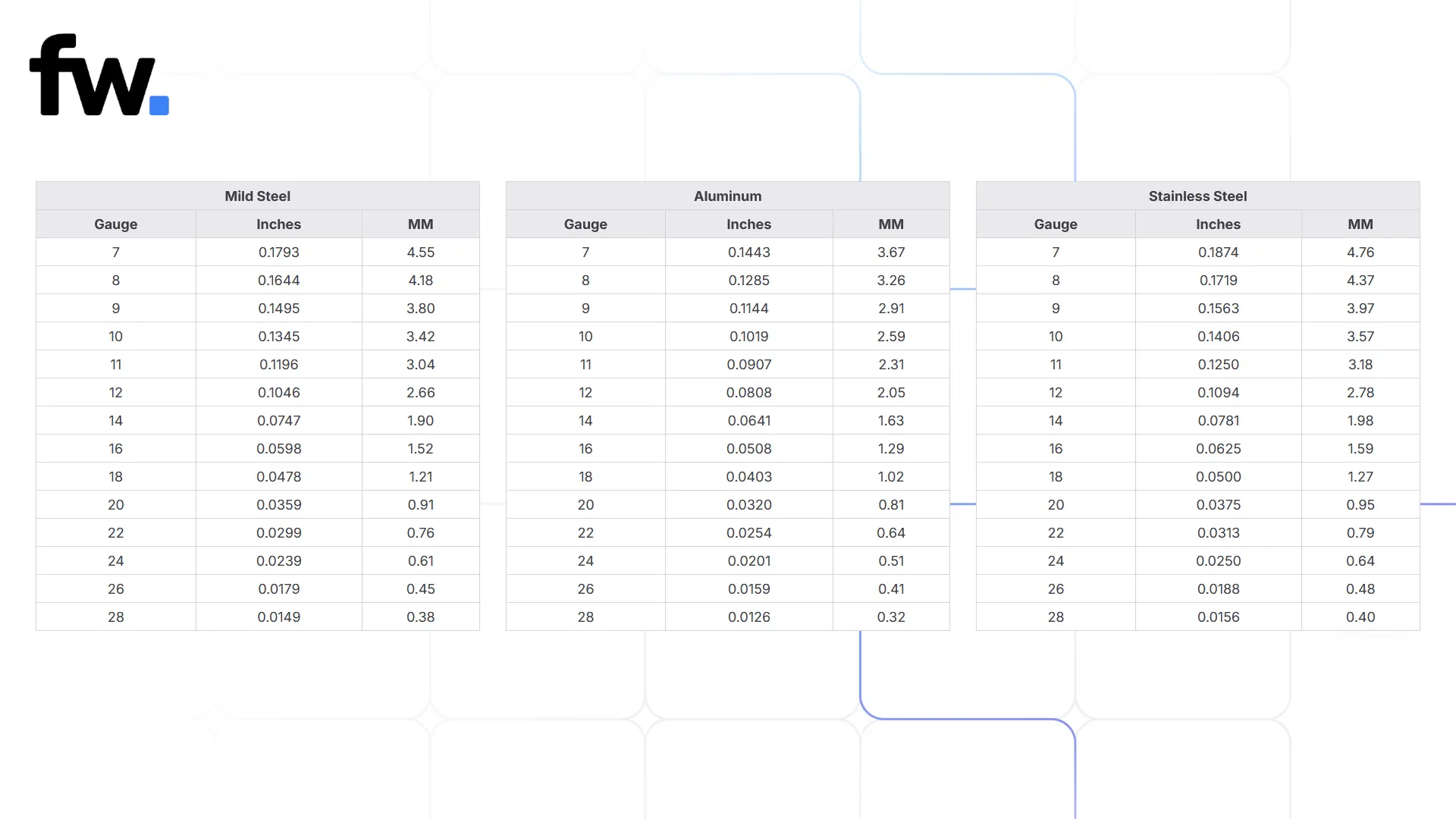
The gauge system is also material-specific: each material follows its own standard. Mild steel uses the Manufacturers Standard Gauge, stainless steel uses a fractional-inch based sheet gauge, and aluminum uses the Brown & Sharpe system. This means 18-gauge stainless (0.050"), 18-gauge steel (0.0478"), and 18-gauge aluminum (0.0403") are all different thicknesses. Always reference a gauge chart for the specific material you're working with. For a comparison of steel and stainless steel properties beyond just thickness, see our Mild Steel vs Stainless Steel guide.
Sheet Metal Gauge Chart
Use this interactive chart to compare materials, switch units, and adjust the gauge range to fit your project.
| Gauge | Aluminum | Steel | Stainless |
|---|---|---|---|
| 7 | 0.1443" | 0.1793" | 0.1875" |
| 8 | 0.1285" | 0.1644" | 0.1719" |
| 9 | 0.1144" | 0.1495" | 0.1563" |
| 10 | 0.1019" | 0.1345" | 0.1406" |
| 11 | 0.0907" | 0.1196" | 0.1250" |
| 12 | 0.0808" | 0.1046" | 0.1094" |
| 13 | 0.0720" | 0.0897" | 0.0938" |
| 14 | 0.0641" | 0.0747" | 0.0781" |
| 15 | 0.0571" | 0.0673" | 0.0703" |
| 16 | 0.0508" | 0.0598" | 0.0625" |
| 17 | 0.0453" | 0.0538" | 0.0563" |
| 18 | 0.0403" | 0.0478" | 0.0500" |
| 19 | 0.0359" | 0.0418" | 0.0438" |
| 20 | 0.0320" | 0.0359" | 0.0375" |
| 21 | 0.0285" | 0.0329" | 0.0344" |
| 22 | 0.0253" | 0.0299" | 0.0313" |
| 23 | 0.0226" | 0.0269" | 0.0281" |
| 24 | 0.0201" | 0.0239" | 0.0250" |
| 25 | 0.0179" | 0.0209" | 0.0219" |
| 26 | 0.0159" | 0.0179" | 0.0188" |
| 27 | 0.0142" | 0.0164" | 0.0172" |
| 28 | 0.0126" | 0.0149" | 0.0156" |
If you plan on ordering parts from Fabworks, design with a stocked gauge. The blue dots in the chart indicate which gauges we carry. Hover a dot to see the exact thickness we stock, which may vary slightly from the chart values. For more in depth material information, see our materials resource pages.
What Sheet Metal Gauge Should I Use for My Project?
The right gauge depends on your part's structural requirements and weight constraints. Here's a general reference:
- 7-10 gauge: Heavy structural parts, industrial frames, thick mounting plates
- 11-14 gauge: General fabrication, enclosures, structural brackets
- 16-18 gauge: The most common range for custom parts. Works well for panels, brackets, and light-duty structural components
- 20-24 gauge: Lightweight housings, electronics enclosures, interior panels
- 26-30 gauge: Thin decorative sheet, metal flashing, non-structural covers
When in doubt, 16 or 18 gauge is a safe starting point for most custom sheet metal parts. If you're still deciding on a material, our material selection guide covers the tradeoffs between aluminum, steel, and stainless in detail.
What to Consider When Choosing a Gauge
- Strength: Heavier gauges (lower numbers) resist deflection and impact. If your part carries load or gets handled roughly, lean thicker.
- Weight: Thinner gauges reduce part weight significantly. For enclosures, panels, and brackets where rigidity isn't critical, this matters.
- Corrosion resistance: Material choice matters more than gauge here, but thicker walls do give more metal for surface treatments like powder coat to grip.
- Cost: Thicker material costs more per part and takes more laser power to cut, which can affect pricing and lead time at heavier gauges.
Frequently Asked Questions
Why does the same gauge number have different thicknesses for different metals?
Gauge numbers were historically tied to the weight of a standard-size sheet, not to a fixed physical measurement. Since different metals have different densities, the same gauge number produces a different thickness depending on the material.
Does a higher gauge number mean thicker or thinner sheet metal?
Thinner. Gauge numbers run in reverse, meaning the higher the number, the thinner the sheet. This is one of the most common points of confusion when dealing with sheet metal gauge for the first time.
What gauge is most common for laser-cut sheet metal parts?
16 and 18 gauge cover the majority of custom laser-cut work - they balance rigidity, formability, and wide material availability across steel, stainless, and aluminum. 14 gauge is the go-to when parts need more structural strength: brackets, frames, and mounting plates that would flex too much at 16 gauge. For heavy structural components, 10-12 gauge is common but may require a different cutting process depending on the material.
How do I convert sheet metal gauge to inches or millimeters?
Use a gauge chart as a reference. Each material has its own chart that lists the thickness in inches and millimeters for each gauge number. Always refer to the correct chart for the material you're working with to get accurate measurements.
Gauge thickness reference by material (gauges 7-28)
- 7 gauge | Steel: 0.1793" (4.55 mm) | Stainless: 0.1875" (4.76 mm) | Aluminum: 0.1443" (3.67 mm)
- 8 gauge | Steel: 0.1644" (4.18 mm) | Stainless: 0.1719" (4.37 mm) | Aluminum: 0.1285" (3.26 mm)
- 9 gauge | Steel: 0.1495" (3.80 mm) | Stainless: 0.1563" (3.97 mm) | Aluminum: 0.1144" (2.91 mm)
- 10 gauge | Steel: 0.1345" (3.42 mm) | Stainless: 0.1406" (3.57 mm) | Aluminum: 0.1019" (2.59 mm)
- 11 gauge | Steel: 0.1196" (3.04 mm) | Stainless: 0.125" (3.18 mm) | Aluminum: 0.0907" (2.30 mm)
- 12 gauge | Steel: 0.1046" (2.66 mm) | Stainless: 0.1094" (2.78 mm) | Aluminum: 0.0808" (2.05 mm)
- 13 gauge | Steel: 0.0897" (2.28 mm) | Stainless: 0.0938" (2.38 mm) | Aluminum: 0.072" (1.83 mm)
- 14 gauge | Steel: 0.0747" (1.90 mm) | Stainless: 0.0781" (1.98 mm) | Aluminum: 0.0641" (1.63 mm)
- 15 gauge | Steel: 0.0673" (1.71 mm) | Stainless: 0.0703" (1.79 mm) | Aluminum: 0.0571" (1.45 mm)
- 16 gauge | Steel: 0.0598" (1.52 mm) | Stainless: 0.0625" (1.59 mm) | Aluminum: 0.0508" (1.29 mm)
- 17 gauge | Steel: 0.0538" (1.37 mm) | Stainless: 0.0563" (1.43 mm) | Aluminum: 0.0453" (1.15 mm)
- 18 gauge | Steel: 0.0478" (1.21 mm) | Stainless: 0.05" (1.27 mm) | Aluminum: 0.0403" (1.02 mm)
- 19 gauge | Steel: 0.0418" (1.06 mm) | Stainless: 0.0438" (1.11 mm) | Aluminum: 0.0359" (0.91 mm)
- 20 gauge | Steel: 0.0359" (0.91 mm) | Stainless: 0.0375" (0.95 mm) | Aluminum: 0.032" (0.81 mm)
- 21 gauge | Steel: 0.0329" (0.84 mm) | Stainless: 0.0344" (0.87 mm) | Aluminum: 0.0285" (0.72 mm)
- 22 gauge | Steel: 0.0299" (0.76 mm) | Stainless: 0.0313" (0.79 mm) | Aluminum: 0.0253" (0.64 mm)
- 23 gauge | Steel: 0.0269" (0.68 mm) | Stainless: 0.0281" (0.71 mm) | Aluminum: 0.0226" (0.57 mm)
- 24 gauge | Steel: 0.0239" (0.61 mm) | Stainless: 0.025" (0.64 mm) | Aluminum: 0.0201" (0.51 mm)
- 25 gauge | Steel: 0.0209" (0.53 mm) | Stainless: 0.0219" (0.56 mm) | Aluminum: 0.0179" (0.45 mm)
- 26 gauge | Steel: 0.0179" (0.45 mm) | Stainless: 0.0188" (0.48 mm) | Aluminum: 0.0159" (0.40 mm)
- 27 gauge | Steel: 0.0164" (0.42 mm) | Stainless: 0.0172" (0.44 mm) | Aluminum: 0.0142" (0.36 mm)
- 28 gauge | Steel: 0.0149" (0.38 mm) | Stainless: 0.0156" (0.40 mm) | Aluminum: 0.0126" (0.32 mm)
Order Sheet Metal Parts .
Upload your STEP file for an instant laser cutting quote. Quote in seconds, order in minutes, receive parts in days.
or drag and drop
.STEP / .STP up to 25MB
Your file are safe, secure and retain all intellectual rights.